. Yeast Display VHH Discovery Service
Yeast Display VHH Discovery Service

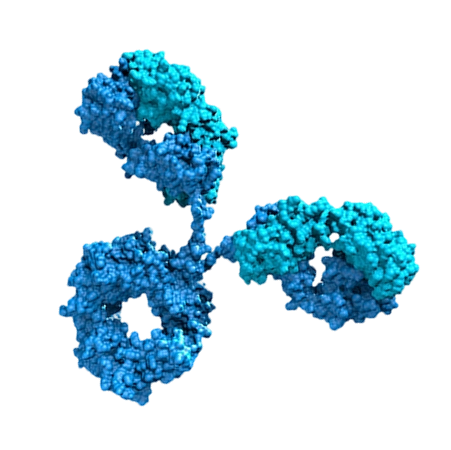
Yeast surface display is a powerful technology for the discovery and optimization of high-affinity nanobodies (VHH). By displaying VHH molecules on the surface of yeast cells, this platform enables quantitative screening and affinity-based selection using fluorescence-activated cell sorting (FACS). Compared with traditional screening methods, yeast display allows precise control of selection conditions and real-time evaluation of binding properties. This makes it particularly suitable for identifying high-affinity nanobody binders against challenging targets. At [Company Name], our Yeast Display VHH Discovery Service integrates high-quality VHH library construction, magnetic bead enrichment, and multi-parameter FACS screening to rapidly isolate specific and high-affinity nanobody candidates for downstream development.

QUICK LINKS:
Request a Quote
First Name*
Last Name*
E-mail*
Company/institution*
Contact Us
No. 99 Haiwang Road, Chengdu, Sichuan, China
+86 400 8677 715
Overview

Yeast surface display is a powerful technology for the discovery and optimization of high-affinity nanobodies (VHH). By displaying VHH molecules on the surface of yeast cells, this platform enables quantitative screening and affinity-based selection using fluorescence-activated cell sorting (FACS). Compared with traditional screening methods, yeast display allows precise control of selection conditions and real-time evaluation of binding properties. This makes it particularly suitable for identifying high-affinity nanobody binders against challenging targets. At [Company Name], our Yeast Display VHH Discovery Service integrates high-quality VHH library construction, magnetic bead enrichment, and multi-parameter FACS screening to rapidly isolate specific and high-affinity nanobody candidates for downstream development.

When to Use Yeast Display for Nanobody Discovery

Yeast display is particularly advantageous for: Discovery of high-affinity VHH binders
Screening against soluble protein antigens
Quantitative affinity-based selection
Affinity maturation of existing nanobody candidates
Screening libraries with precise control of binding conditions

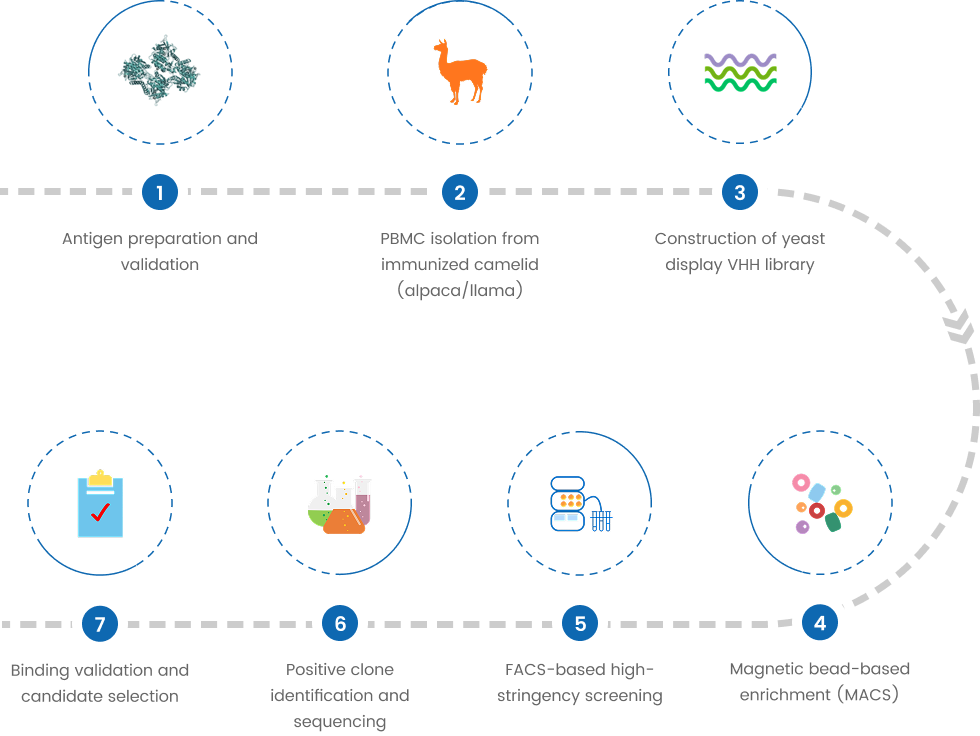
Our Yeast Display VHH Discovery Workflow
Deliverables
Clients will receive

High-affinity VHH binder sequences
Clone information and sequence alignment
Binding validation data
Expression-ready constructs
Comprehensive project report

Optional downstream services
Typical Project Timeline
Package Service Step Deliverables Timeline
Basic Yeast VHH Library Construction High-quality yeast VHH display library ~4 weeks
Basic Yeast Display Screening Target-binding VHH sequences and screening report 4–6 weeks
Basic Candidate Production Purified VHH or VHH-Fc antibodies ~2 weeks
Basic Characterization Binding affinity and blocking profile 1–2 weeks
* The timeline above covers the yeast display library construction <br> and screening stages of nanobody discovery. If camelid immunization is required, an additional 6–8 weeks may be needed. 

Need Camelid Immunization For Your Project?

Explore our Animal Immunization Service
Advantages of Yeast Display Screening

Compared with other discovery technologies, yeast display provides several advantages:
Quantitative affinity-based selection using FACS
Reduced false-positive rates
High display levels (10⁴–10⁵ copies per cell)
Real-time monitoring of binding signals
Direct genotype-phenotype linkage
Eukaryotic expression system closer to mammalian folding

Why Choose Our Yeast Display VHH Discovery Service
Extensive Experience
Our team has extensive experience in nanobody discovery and yeast display screening across a wide range of targets.
High-Quality VHH Libraries
We construct high-diversity libraries with capacities exceeding 1 × 10⁸ clones, ensuring broad coverage of potential binders.
Advanced FACS Screening
Multi-color flow cytometry enables precise affinity-based selection under controlled screening conditions.
Low False Positive Rate
The combination of MACS enrichment and FACS sorting significantly reduces non-specific binders.

Case Study

Integrated NGS Analysis
DOWNLOAD
FAQs
How does yeast display support nanobody discovery?

Yeast display technology enables surface expression of individual nanobody sequences on yeast cells, supporting high-throughput screening of billions of variants for target-specific binding. Coupled with fluorescence-activated cell sorting (FACS), this platform enables rapid isolation of high-affinity nanobody candidates, with significantly shortened R&D timelines relative to conventional discovery approaches.

Can you generate nanobodies against challenging targets like membrane proteins and small molecules?

Our yeast display platform is fully compatible with challenging targets, including multi-pass transmembrane proteins and small-molecule haptens. Customized library design and tailored screening workflows enable robust generation of high-quality binders, even for targets with low immunogenicity or complex structural features, with markedly improved discovery success rates.

How is yeast display different from phage display for nanobody discovery?

Key differences:

Yeast display: high-resolution affinity sorting (FACS-based)

Phage display: large-scale library enrichment

Yeast display: better for affinity maturation and fine selection

Phage display: better for initial hit discovery

When should I choose yeast display for my nanobody project?

Yeast display is particularly suitable when:

High-affinity binders are required

Fine affinity discrimination is important

Target is a soluble protein or well-characterized antigen

Affinity maturation is needed

Precise selection pressure control is required

It is also highly effective for downstream functional antibody development.

Can yeast display be used for membrane protein targets?

Yes, but typically with recombinant extracellular domains or engineered antigen formats.
Yeast display is more suitable for purified recombinant protein screening and well-folded, structurally stable antigens. It is generally less ideal for direct cell-based selection due to larger cell size and higher background in cell-sorting assays, which can reduce specificity resolution.

What library size can yeast display achieve?

Our Yeast display libraries can reach 10⁸ range (garanteed quality).

While smaller than phage display libraries, yeast display compensates with functional screening precision and affinity-based selection power.

Can yeast display be used for affinity maturation?

Yes. Yeast display is one of the most commonly used platforms for

affinity maturation and binding optimization under controlled conditions. 

It allows fine discrimination between closely related variants.

See Our Wide Array of NANOBODY Services
Immunogen Design & Production
Camelid Immunization
Phage Display Nanobody Discovery
Functional Characterization
Yeast Display Nanobody Discovery
Premade Library Screening
Yeast Display Peptide Library Screening
Nanobody Discovery for ADC Development
Yeast Display Nanobody Discovery
Premade Library Screening
Yeast Display Peptide Library Screening
Nanobody Discovery for ADC Development
Related Services
Request a Quote