No need for animal immunization
Flexible screening strategies (panning or FACS)
Suitable for a wide range of targets
Rapid identification of candidate binders
How We Select the Right Premade VHH Library for Your Target
Selecting a suitable VHH library is an important first step in a successful Premade Nanobody Library Screening Service. Rather than using the same screening route for every project, NBbiolab evaluates the target characteristics, screening objective, required binder properties, and downstream application before recommending an appropriate library and selection strategy.
Target Characteristics
Different targets can require different screening considerations. Soluble proteins, extracellular domains, membrane-associated targets, and structurally complex antigens may present different accessibility, conformation, and specificity challenges. Before screening, we consider factors such as: • Target format and biological relevance • Antigen availability and quality • Expected epitope accessibility • Potential cross-reactivity with related proteins • Whether native conformation needs to be preserved • Downstream assay or application requirements This helps determine how the available premade VHH library resources can be used more effectively for each project.
Screening Objective
The ideal screening strategy also depends on what the selected VHH candidates will be used for. For example, a project focused on initial target validation may prioritize rapid identification of diverse binders, while a therapeutic discovery project may require more attention to specificity, binding performance, sequence diversity, and downstream engineering potential. By defining the project objective before screening begins, NBbiolab can design a more focused Nanobody Library Screening Service rather than simply performing a standard selection process.
Screening Platform Selection
NBbiolab integrates both Phage Display Nanobody Discovery and Yeast Display VHH Discovery capabilities. Phage display can support efficient enrichment from highly diverse libraries, while yeast display can provide additional flexibility for fluorescence-based and quantitative selection strategies. The platform is selected according to the characteristics of the target and the screening goal rather than treating all projects in the same way.
Target-Specific Nanobody Library Screening Strategy
A large library alone does not guarantee useful VHH candidates. Effective nanobody library screening also depends on how the selection conditions are designed around the target. NBbiolab develops target-specific screening strategies based on the biological and technical requirements of each project. Depending on the project, the strategy may consider: • Appropriate antigen presentation during selection • Selection pressure across different screening rounds • Enrichment of target-specific VHH clones • Reduction of unwanted or non-specific binding • Preservation of sequence diversity during candidate selection • Selection conditions related to the intended downstream assay For straightforward targets, a conventional enrichment strategy may be sufficient. For more demanding targets, screening conditions can be adjusted progressively to improve discrimination between desirable and undesirable binders. This project-specific approach is particularly important when the goal is not simply to identify a positive clone, but to obtain a panel of VHH candidates that can support subsequent comparison, validation, and lead selection. For customers considering broader recombinant antibody library screening or custom antibody library screening, the same principle applies: the screening design should be determined by the target and development objective rather than by library size alone.
How We Improve Screening Specificity and Candidate Quality
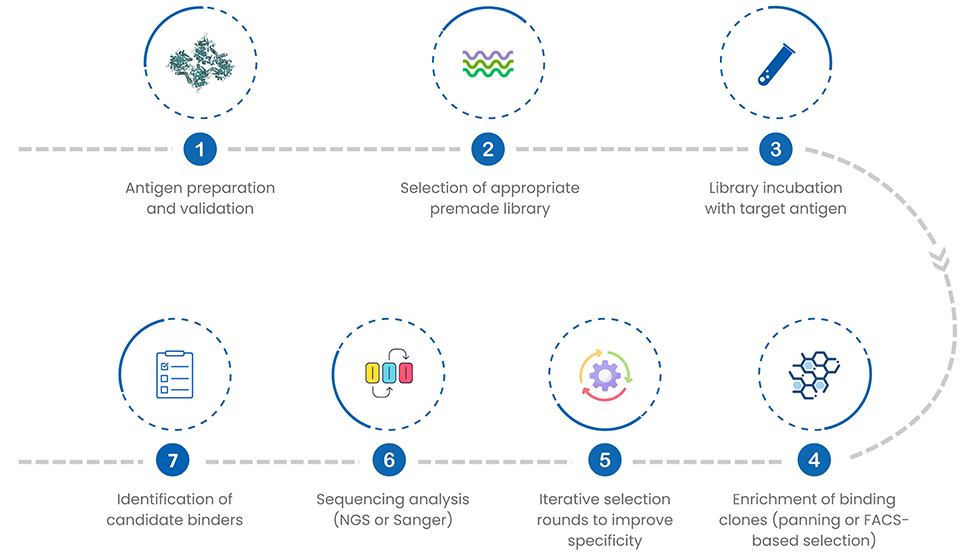
One of the main challenges in antibody library screening is separating useful target-specific binders from non-specific, weak, or assay-dependent signals. NBbiolab combines enrichment, clone screening, sequence analysis, and downstream validation to improve the quality of candidates selected from premade VHH libraries.
Controlled Selection Stringency
Selection conditions can be adjusted across screening rounds to gradually enrich desirable VHH binders. The goal is to maintain sufficient diversity during early screening while increasing the ability to distinguish stronger and more specific candidates as selection progresses.
Positive and Negative Selection Considerations
Where appropriate for the target and project design, selection strategies can include conditions intended to reduce unwanted binding and improve target discrimination. This can be particularly useful when related proteins, background components, or target presentation may influence screening specificity.
Clone Screening and Sequence Analysis
Enriched clones are not evaluated solely on a positive screening signal. Sequence information can help identify unique VHH families, reduce redundant clone selection, and support the selection of a more diverse candidate panel for subsequent characterization.
Independent Binder Validation
Promising candidates can be further evaluated using appropriate binding and functional assays. This additional validation step helps distinguish reproducible VHH binders from clones that only perform under a particular screening condition. The result is a more useful set of candidates for downstream research, diagnostic development, or therapeutic discovery.
From Premade Library Screening to Qualified VHH Candidates
The objective of a Premade Nanobody Library Screening Service is not simply to produce a list of positive clones. For many projects, the real value begins when screening hits are converted into characterized and development-ready VHH candidates. After initial library screening, selected VHH clones can move through several downstream stages according to project requirements.
Candidate Sequence Identification
Positive clones can be sequenced to identify unique VHH candidates and group related sequences. This helps establish candidate diversity and provides a basis for selecting representative clones for further evaluation.
Recombinant Expression and Binding Confirmation
Selected VHH candidates can be expressed recombinantly and tested independently from the original display system. This is an important step for confirming that the observed binding activity is retained after recombinant production.
Affinity and Functional Evaluation
Depending on the project objective, candidates can be characterized further for binding affinity, specificity, functional activity, internalization, or other relevant properties. The required validation strategy is determined by the intended use of the nanobody rather than applying unnecessary assays to every project.
Downstream Nanobody Engineering
Promising VHH candidates may also progress into downstream optimization, including affinity maturation, humanization, format engineering, and additional developability evaluation when required. This allows customers to move from initial nanobody library screening toward a more complete discovery and development workflow without repeatedly transferring the project between unrelated service providers.
Why Choose NBbiolab for Premade Nanobody Library Screening
NBbiolab is a specialized CRO focused on nanobody and single-domain antibody discovery, engineering, and development. Our premade library screening service is supported by dedicated VHH discovery platforms rather than being offered as a small extension of a general antibody service.
Specialized Nanobody Discovery Experience
NBbiolab has focused on VHH and single-domain antibody technologies since 2017. Our scientific team has extensive experience in nanobody discovery projects involving library screening, candidate validation, engineering, and downstream development. This specialization allows screening decisions to be made from a nanobody-development perspective rather than relying on a generic antibody workflow.
Integrated Phage and Yeast Display Platforms
Access to both phage display and yeast display capabilities provides greater flexibility when designing a screening project. Instead of forcing every target into one platform, the screening approach can be selected according to target characteristics, selection requirements, and the properties expected from the final VHH candidates.
Established Premade VHH Library Resources
NBbiolab maintains premade VHH library resources from multiple camelid sources, allowing suitable projects to begin screening without going through a new animal immunization and library construction cycle. This can significantly simplify projects where rapid access to diverse VHH candidates is the primary objective.
From Screening to Downstream Engineering
Library screening is only one part of nanobody discovery. NBbiolab can support subsequent recombinant expression, affinity evaluation, functional characterization, affinity maturation, humanization, and other downstream development activities according to project requirements. This integrated workflow makes it easier to move promising screening hits into more advanced development stages.
Proven Nanobody Project Experience
NBbiolab has worked with more than 300 biotechnology companies, biopharmaceutical companies, and universities, and has supported more than 1,000 single-domain antibody pre-discovery projects. Our experience covers both research-oriented nanobody projects and programs progressing toward more advanced drug discovery and development.
Start Your Premade Nanobody Library Screening Project
If you already have a validated target and want to identify VHH binders without starting a new immunization and library construction cycle, NBbiolab can help evaluate the most suitable premade library and screening strategy for your project.
Share your target information, antigen format, intended application, and desired candidate characteristics with our scientific team. We can help define a practical screening route from library selection through VHH candidate validation and downstream development.
Discuss Your Nanobody Library Screening Project



 Yeast Display VHH Discovery Service
 Immunogen Design & Production
 Premade Library Screening
 Phage Display Nanobody Discovery Service
 Animal Immunization
 Yeast Display Peptide Library Screening

 Nanobody Discovery for ADC
 Nanobody Discovery for Membrane Targets
 Nanobody Discovery for Cell Therapy
 TCR-Mimic Nanobody Discovery


 Antibody Affinity Maturation Service
 Nanobody Humanization Service



 What are the advantages of your company's natural single-domain antibody library?