.
Premade library screening enables rapid identification of target-binding molecules without the need for animal immunization or custom library construction. By using high-quality, preconstructed libraries, this approach significantly reduces project timelines while maintaining high screening efficiency.
We offer screening services based on a diverse collection of premade display libraries. These libraries support the discovery of binding molecules against a wide range of targets, including soluble proteins, receptors, and challenging antigens.
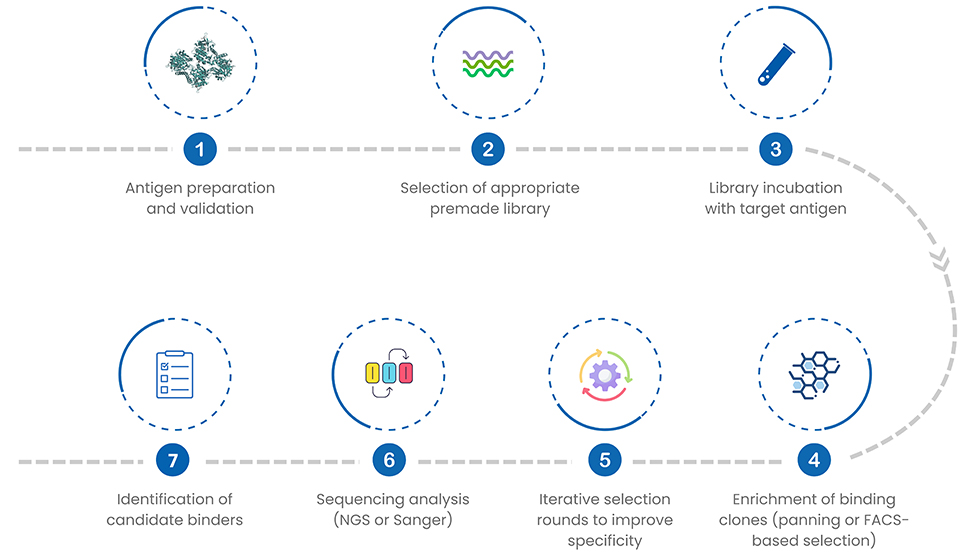
Our premade library screening service integrates optimized panning or FACS-based selection strategies with sequencing analysis to efficiently identify candidate binders for downstream applications.
Premade library screening is an ideal approach when rapid binder discovery is required without the time and cost associated with animal immunization or custom library construction. This strategy is particularly suitable in the following scenarios:
Early-stage target validation
Quickly identify binding molecules to evaluate target feasibility before committing to full discovery campaigns.
Projects with tight timelines
When rapid turnaround is critical, premade libraries enable binder identification within weeks.
Non-immunogenic or toxic targets
Suitable for targets that are difficult to immunize in animals or may cause poor immune responses.
Challenging targets
Applicable for screening against difficult targets where traditional approaches may be limited.

We provide large naïve VHH libraries using PBMCs and spleens from more than 50 healthy nonimmunized Alpacas/Llamas/Camels separately.
Features
Large capacity: 109-1010 individual transformants with more than 90 % unique sequences
High insertion rate: The positive insert ratio was more than 99.99%.
| Code | Description | Applications |
| AlpSDAb-P | Phage display based Naïve VHH Library from Alpaca | phage display library for screening |
| CamSDAb-P | Phage display based Naïve VHH Library from Camel | phage display library for screening |
| LiaSDAb-P | Phage display based Naïve VHH Library from Llama | phage display library for screening |
| CamSDAb-Y | Yeast display based Naïve VHH Library from Camel | yeast display library for screening |

Selected candidates can undergo preliminary validation to confirm target binding. Optional downstream characterization services are available for detailed analysis.
Typical validation approaches include:
ELISA-based binding assays
Flow cytometry binding analysis
Competitive binding assays
Functional assays (if applicable)
|
Package |
Service Step |
Deliverables |
Timeline |
|
Basic |
Library screening |
Enriched binder sequences and screening report |
2–4 weeks |
|
Optional |
Candidate production |
Expression-ready constructs and VHH antibodies |
2 weeks |
|
Optional |
Binder validation |
Binding confirmation and functional data |
1–2 weeks |
No need for animal immunization
Flexible screening strategies (panning or FACS)
Suitable for a wide range of targets
Rapid identification of candidate binders
What are the advantages of your company's natural single-domain antibody library? The advantages of our natural single-domain antibody library are as follows:
1. Diverse species sources, covering PBMCs from three hosts: camel, llama and alpaca;
2. Library capacity reaches the 10¹¹ level, with unique sequence proportion over 90%;
3. Target fragment insertion rate of the library is as high as 99%;
4. Both phage library and yeast display library are available for parallel screening.
When should a natural library be selected for single-domain antibody screening? Natural library screening is applicable for difficult-to-immunize targets with high homology to alpacas/camels that cannot induce effective immune responses. It is also suitable for projects with low requirements on antibody affinity.