. Nanobody Humanization Service
Nanobody Humanization Service

Therapeutic antibodies and nanobodies may trigger anti-drug antibody (ADA) responses, potentially impacting Drug safety, Pharmacokinetics, Therapeutic efficacy and Clinical tolerability.

Humanization helps reduce immunogenicity risk while preserving the functional properties of the original nanobody.

QUICK LINKS:
Request a Quote
First Name*
Last Name*
E-mail*
Company/institution*
Contact Us
No. 99 Haiwang Road, Chengdu, Sichuan, China
+86 400 8677 715
Nanobody Humanization Service

Nanobody humanization is a critical step in the development of therapeutic VHH candidates. Although camelid-derived nanobodies exhibit many favorable drug-like properties, their non-human sequences may still introduce immunogenicity risks in clinical applications.


Successful humanization requires more than simple sequence replacement. Humanized nanobodies must retain binding affinity, specificity, stability, and developability while minimizing potential immune responses.


Our nanobody humanization workflows integrate sequence analysis, structural modeling, immunogenicity assessment, and rational engineering strategies to generate humanized VHH candidates with optimized therapeutic potential.

Key goals in Nanobody Humanization

Maintaining Affinity

Preserving Stability

Minimizing Immunogenicity

Maintaining Developability

Advantages of Our Nanobody Humanization Platform

Immunogenicity-focused optimization

Preservation of affinity and stability

Integrated developability assessment

Flexible downstream validation support

Our Humanization Strategy

Our workflows combine computational analysis with rational sequence engineering.


Structural Modeling and CDR Preservation

Homology modeling and structural analysis help preserve CDR conformations critical for target binding.


Rational Back-Mutation Design

Selective back-mutations are introduced when necessary to recover affinity or stability.


Immunogenicity Assessment

In silico analysis is performed to identify potential immunogenic sequence liabilities.


PTM and Developability Analysis

Evaluation of Potential post-translational modification sites, aggregation risk, sequence liabilities and expression-related features

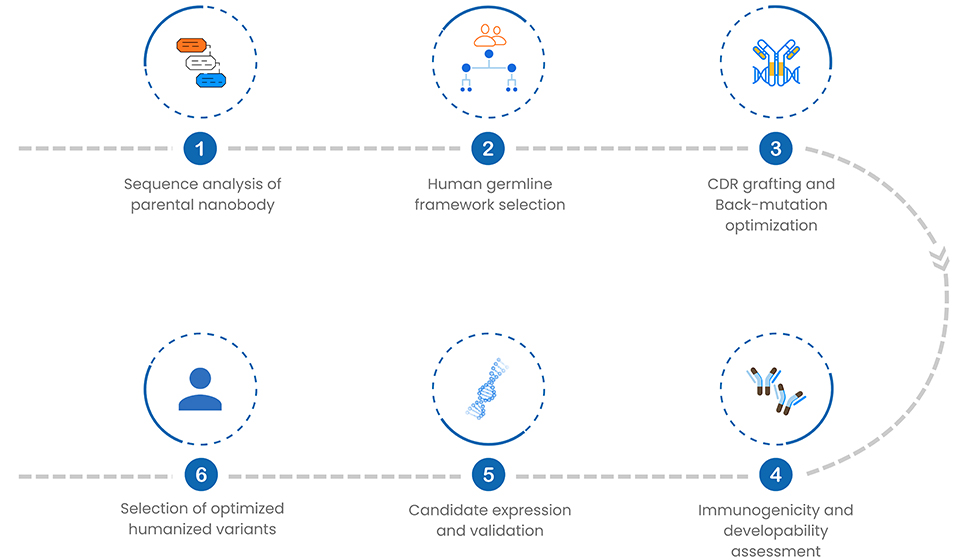
Humanization Workflow

Nanobody Humanization Service

Typical Project Timeline

Service Step

Deliverables

Timeline

In silico humanization &

Developability analysis

Humanized sequence panel and analysis report

1 week

Candidate expression

Purified humanized VHH proteins

2 weeks

Binding validation

Affinity and binding analysis results

1 week

Representative Case Study

Table 1. Humanization of a Therapeutic Nanobody Candidate

Antigen

Loading Sample ID

KD (M)

kon(1/Ms)

kdis(1/s)

Full X^2

Full R^2

Human protein

C6-HZ

3.46E -09

1.45E+05

5.02E-04

0.006

0.9988

C6

3.728-09

1.39E+05

5.15E-04

0.0134

0.9985

Cyno protein

C6-HZ

2.78E-08

2.00E+03

5.56E-05

0.0096

0.9993

C6

2.14E-08

2.42E+03

3.05E-05

0.011

0.9995

Binding affinity of a nanobody candidate was evaluated before and after humanization against both human and cynomolgus monkey targets. Affinity reduction after humanization remained within an acceptable range while maintaining functional binding characteristics. C6: pre-humanized antibody; C6-Hz: post-humanized antibody
FAQs
What is the workflow of single-domain antibody humanization? What are the deliverables and success criteria?

Single-domain antibody humanization adopts the classic CDR grafting & back mutation method. Deliverables include humanized antibody sequences, recombinant humanized antibody proteins and project reports. The success criterion is that the affinity loss of the humanized sequence is no more than 3-fold compared with the parental sequence.

What is the cycle of single-domain antibody humanization?

The overall cycle of single-domain antibody humanization is generally 4 weeks: 1 week for humanized antibody design, 2 weeks for protein expression of humanized antibodies, and 1 week for activity and affinity validation.

Which factor deserves more attention for single-domain antibodies, humanization level or immunogenicity?

Even fully human antibodies may induce anti-drug antibodies (ADA). The immunogenicity of single-domain antibodies deserves more attention than humanization level.

See Our Wide Array of NANOBODY Services
Immunogen Design & Production
Camelid Immunization
Phage Display Nanobody Discovery
Functional Characterization
Yeast Display Nanobody Discovery
Premade Library Screening
Yeast Display Peptide Library Screening
Nanobody Discovery for ADC Development
Yeast Display Nanobody Discovery
Premade Library Screening
Yeast Display Peptide Library Screening
Nanobody Discovery for ADC Development
Related Services
Request a Quote