|
Package
|
Service Step
|
Deliverables
|
Timeline
|
|
Basic
|
Immunogen production
|
Prepared immunogen materials
|
2–4 weeks
|
|
Basic
|
Functional validation
|
Validation data
|
1–2 weeks
|
Immunogen preparation can typically be completed within 3–5 weeks, depending on the format and project complexity. For cell-based immunogens requiring the generation of stable monoclonal cell lines, the timeline may extend to approximately 8 weeks.
How We Select the Right Immunogen for Nanobody Discovery
The choice of immunogen can directly influence the quality and diversity of the immune response generated during a nanobody discovery program. At NBbiolab, immunogen selection begins with an evaluation of target biology, structural characteristics, epitope accessibility, membrane localization and downstream discovery requirements.
Soluble and Secreted Protein Targets
For soluble proteins or extracellular domains that can be produced in a stable and properly folded form, recombinant protein immunogens are generally a practical option. Protein design, expression strategy and preparation conditions are considered together to help preserve relevant epitopes for subsequent VHH discovery.
Membrane and Cell-Surface Targets
Membrane proteins can be difficult to isolate while maintaining their native structure. For these targets, cell-based immunogens, LNP-mRNA or viral vector-based strategies may be considered to present the target in a more biologically relevant environment. This can be particularly useful when conformational or extracellular epitopes are important for nanobody discovery for membrane protein targets.
Conformation-Sensitive Targets
Some nanobody discovery programs depend on binders recognizing a specific three-dimensional structure rather than a linear sequence. In these cases, the immunogen strategy places greater emphasis on maintaining native-like conformation and appropriate epitope presentation during immunization.
Difficult-to-Express or Purify Targets
When purified recombinant protein is unstable, difficult to express or unsuitable for immunization, alternative antigen presentation strategies may provide a better option. NBbiolab evaluates whether cell-based, LNP-mRNA, viral vector or other supported approaches are more appropriate according to the characteristics of the target.
Selection Based on Downstream Discovery Goals
Immunogen preparation is also planned according to the intended downstream workflow. Whether the project proceeds to camelid immunization, immune response monitoring, VHH library construction or subsequent nanobody screening, the immunogen format is selected as part of the overall discovery strategy rather than as an isolated production step.
What Makes an Immunogen Suitable for Nanobody Discovery?
A successful immunogen is not defined by purity alone. For nanobody discovery, the immunogen should present biologically relevant epitopes, remain compatible with the selected immunization strategy, and support an appropriate immune response. NBbiolab evaluates immunogen quality from both production and downstream discovery perspectives.
Biologically Relevant Epitope Presentation
The immunogen should expose epitopes that are relevant to the intended discovery objective. This is particularly important when the program targets functional sites, extracellular domains or structurally defined regions of a protein.
Appropriate Structural Conformation
For targets where three-dimensional structure influences antibody recognition, maintaining a native-like conformation can be important. Immunogen design and preparation therefore consider folding, structural integrity and the accessibility of conformational epitopes.
Suitable Purity and Sample Quality
Sample purity, integrity and composition can influence immune response quality and downstream screening specificity. Prepared immunogens should meet the quality requirements established for the selected immunization strategy before entering the next stage of the project.
Stability During Preparation and Immunization
A suitable immunogen should remain sufficiently stable during preparation, handling and immunization. Aggregation, degradation or loss of relevant structure may influence antigen presentation and affect subsequent VHH discovery.
Compatibility with Camelid Immunization
The immunogen format, formulation and preparation quality should be compatible with the planned camelid immunization strategy, allowing immunogen preparation to connect naturally with immune monitoring and later VHH library construction.
Alignment with Downstream Nanobody Screening
Immunogen preparation should support the final discovery objective. Target format, epitope presentation and immunization strategy are therefore considered together with downstream VHH library construction and screening requirements rather than optimized as isolated steps.
From Immunogen Preparation to Nanobody Discovery
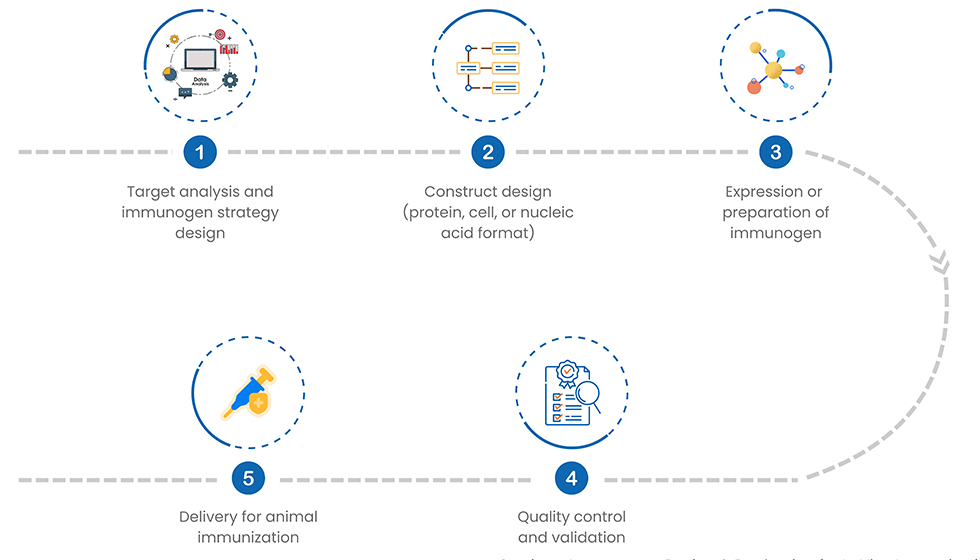
Immunogen preparation is the starting point of an immunization-based nanobody discovery program. At NBbiolab, antigen design and production can be connected with camelid immunization, immune response monitoring, VHH library construction and downstream binder screening.
Target Evaluation
The project begins with an evaluation of target biology, structure, localization, epitope requirements, expression feasibility and the intended nanobody application.
Immunogen Design and Preparation
Based on target characteristics, an appropriate recombinant protein, cell-based, LNP-mRNA, viral vector or other supported immunogen strategy can be selected. The immunogen is then prepared and evaluated before downstream use.
Camelid Immunization and Immune Monitoring
The prepared immunogen can proceed into NBbiolab's camelid animal immunization workflow. Immune response monitoring helps determine whether the immunization has generated a suitable response before subsequent library construction.
VHH Library Construction and Screening
Immune samples can then proceed to VHH library construction and downstream phage display nanobody discovery or yeast display VHH discovery, depending on project requirements.
This integrated workflow allows the immunogen preparation service for nanobody discovery to be planned around downstream requirements from the beginning rather than treating antigen production as an isolated step.
Why Choose NBbiolab for Immunogen Preparation?
Immunogen preparation for VHH discovery requires more than antigen production alone. As a specialized nanobody discovery CRO, NBbiolab combines target-oriented immunogen strategy with camelid immunization, VHH library construction and downstream screening platforms.
Nanobody-Focused Expertise
NBbiolab specializes in nanobody and VHH discovery. Our team has extensive experience supporting projects from target and immunogen strategy through immunization, library construction, screening and subsequent candidate development.
Multiple Immunogen Strategies
We support recombinant proteins, cells, LNP-mRNA, viral vector-based antigens and other immunogen formats, providing flexibility for soluble proteins, membrane-associated targets and difficult-to-prepare antigens.
Integrated Camelid Immunization Capability
Prepared immunogens can transition directly into NBbiolab's camelid immunization platform. This allows immunogen design and preparation to be coordinated with immunization strategy and subsequent VHH discovery requirements.
Immune Response Monitoring
ELISA- and FACS-based methods can be used to monitor immune responses during immunization, helping evaluate project progression before downstream VHH library construction and screening.
Phage and Yeast Display Platforms
Immunization-derived samples can be connected with NBbiolab's phage display and yeast display platforms for VHH library construction, binder enrichment and nanobody candidate identification.
Integrated Nanobody Discovery Support
Because immunogen preparation is part of a broader discovery workflow at NBbiolab, customers can connect antigen preparation with immunization, library construction and screening without treating each stage as an independent service.
Start Your Nanobody Immunogen Preparation Project
Not sure which immunogen format is suitable for your target? Share your target information and discovery objectives with the NBbiolab team. Our scientists can evaluate target characteristics and help develop an immunogen preparation strategy aligned with subsequent camelid immunization and nanobody discovery.
Discuss Your Project



 Yeast Display VHH Discovery Service
 Immunogen Design & Production
 Premade Library Screening
 Phage Display Nanobody Discovery Service
 Animal Immunization
 Yeast Display Peptide Library Screening

 Nanobody Discovery for ADC
 Nanobody Discovery for Membrane Targets
 Nanobody Discovery for Cell Therapy
 TCR-Mimic Nanobody Discovery


 Antibody Affinity Maturation Service
 Nanobody Humanization Service



 What are the requirements for immunogen concentration, purity and endotoxin level in alpaca immunization?