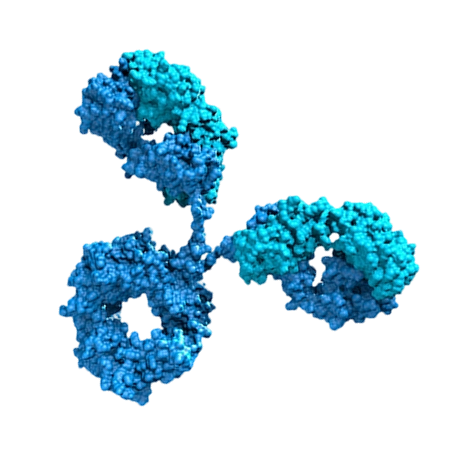
Generate strong and diverse VHH immune responses through customized camelid immunization using alpacas, llamas, or camels, with immune monitoring and PBMC collection to support downstream nanobody discovery.
Binder Discovery
Application-Specific Nanobody Discovery
Our Llama and Alpaca Immunization Service supports immunization-based VHH discovery projects from antigen administration through immune response monitoring and PBMC collection. Immunization strategies can be tailored according to target characteristics, antigen format, and project requirements to help generate a diverse antigen-specific VHH immune repertoire.
We support multiple immunogen formats, including recombinant proteins, peptides, whole cells, VLPs, LNP-mRNA, and viral vector-based antigens. For projects that require antigen development before immunization, our Immunogen Design & Production service can support the preparation and optimization of suitable immunogens.
Following camelid animal immunization, immune responses are monitored and PBMCs are collected for downstream VHH library construction and nanobody screening.
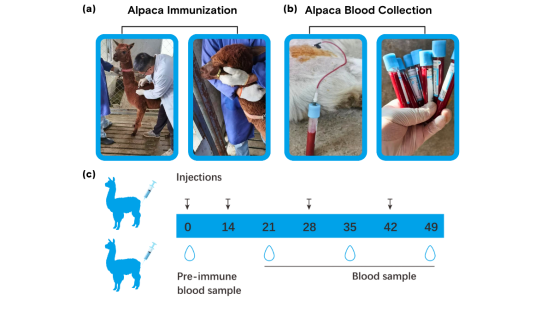
Our standard immunization program spans approximately 49 days, designed to achieve strong and sustained immune responses.
Four antigen injections at two-week intervals
Three blood collection timepoints for immune monitoring
PBMC collection for downstream library construction
This approach ensures efficient maturation of antigen-specific VHH responses and supports high-quality nanobody discovery.

Figure 1. Animal Immunization and Blood Collection
(a) Alpaca immunization procedure. (b) Blood collection from alpaca. (c) 49-day immunization timeline. Black arrows indicate injection days (Days 0, 14, 28, 42), and droplet icons represent blood collection (Days 0, 21, 35, 49). Day 0 serum is used as a negative control, while samples collected after immunization are used to measure immune response by titer testing.
We support a wide range of immunogen formats to address diverse target types:
Recombinant proteins
Peptides
Whole cells
Virus-like particles (VLPs)
LNP-mRNA
Adenoviral or other viral vector-based antigens
Flexible antigen formats enable successful immunization of challenging targets, including membrane proteins and poorly immunogenic molecules.
Our immunization workflows are fully customizable based on target characteristics and project goals.
| Immunization Species | Adjuvant Options |
| Alpaca Llama Camel |
Freund’s adjuvant Proprietary water-soluble adjuvants |
| Injection Routes | Strategy Optimization |
| Subcutaneous Intramuscular Nasal administration |
We optimize antigen format, dosing schedule, and delivery method to maximize immune response and nanobody diversity. |
We monitor immune responses throughout the immunization process to ensure successful antibody generation.
ELISA-based serum titer analysis
Flow cytometry (FACS) analysis
VHH-specific detection assays
These methods allow real-time evaluation of antibody development and optimization of immunization strategies.
Clients will receive:
Pre-immune serum
Immune serum samples
Isolated PBMCs for library construction
Serum titer and immune response data
Comprehensive project report
Optional services:
Nanobody library construction and screening
High-Quality, Naïve Animals
All animals are verified to have no prior exposure to target antigens, ensuring clean immune backgrounds and unbiased antibody generation.

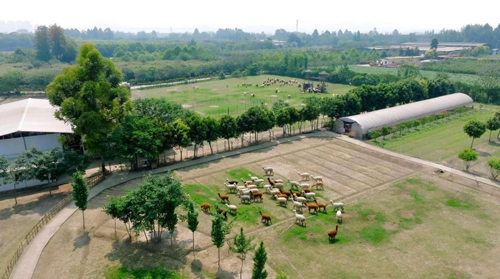
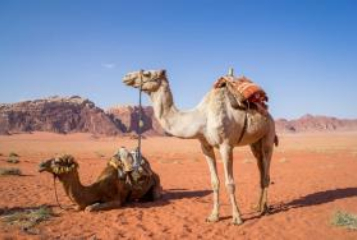
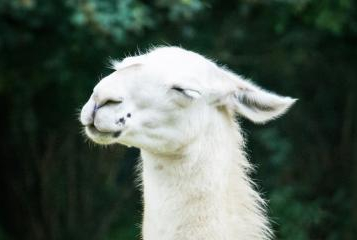
Figure 2. Our dedicated 40-acre farm houses high-quality alpacas and llamas imported from South America. With expert breeding and veterinary care, we ensure optimal animal health and project confidentiality.
Customized Immunogen Design
We tailor each antigen to your target and application, offering custom design and preparation of mRNA, VLPs, fusion proteins, and more. Every format is optimized to improve immunogenicity, preserve structural integrity, and ensure reliable downstream VHH discovery.
Proprietary Adjuvant Technology
Our camelid-optimized adjuvants enhance immune responses and boosts HcAb titer while maintaining antigen integrity and minimizing toxicity.

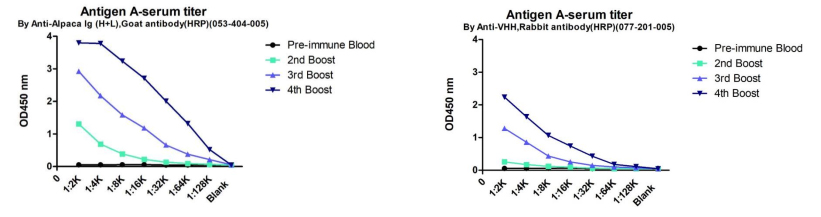
Figure 3. Serum titers following alpaca immunization with a camelid immune adjuvant and antigen mixture. The left panel shows total IgG titers after four immunizations; the right panel shows VHH titers. The X-axis represents serum dilution, and the Y-axis indicates OD values measured by ELISA.
Advanced Immune Monitoring
Integrated ELISA and FACS-based assays enable precise monitoring of antibody development.
Proprietary VHH Detection Antibody
Our in-house detection antibody allows sensitive and specific quantification of VHH titers without cross-reactivity.

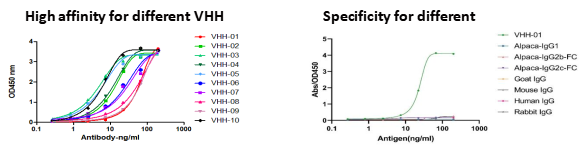
Figure 4. Left: Our AlpHcAb detection antibody demonstrates high affinity across diverse VHH sequences. Right: It shows strong specificity for VHHs without binding other alpaca or cross-species IgGs.
Seamless Integration with Discovery Platforms
Direct compatibility with phage display / yeast display library construction and screening workflows.
|
Genus |
Common Name |
Scientific Name |
% Heavy-chain Antibodies vs. Total Antibodies |
% with Extra Disulfide Bonds |
V Region Homology to Human (%) |
|
Camel |
Bactrian Camel
|
Camelus bactrianus |
~70% |
~80% |
65~70% |
|
Lama |
Llama
|
Lama glama |
~45% |
~10% |
>80% |
|
Alpaca |
Alpaca
|
Vicugna pacos |
~45% |
~10% |
>80% |
|
Package |
Service Step |
Deliverables |
Timeline |
|
Optional |
Immunogen preparation |
Prepared immunogen and QC report |
2–6 weeks |
|
Basic |
Animal immunization & monitoring |
Serum samples, PBMCs, project report |
~7 weeks |
A standard camelid immunization program requires approximately 7 weeks.
If immunogen preparation is included, the total timeline may extend to 9–13 weeks, depending on antigen format and complexity.
A successful camelid immunization project begins with selecting an appropriate immunogen and defining the intended downstream VHH discovery strategy. Before starting immunization, it is useful to consider the target type, available antigen format, desired immune response, and how the collected PBMCs will be used in subsequent library construction and screening.
For projects that still require antigen design, production, or format optimization, our Immunogen Design & Production service can support the preparation of suitable immunogens before alpaca or llama immunization.
Key information typically considered during project planning includes:
Camelid animal immunization is commonly used when a project requires an immune-derived VHH repertoire enriched against a specific target. Alpacas and llamas naturally produce heavy-chain-only antibodies, making their immune response particularly suitable for generating VHH sequences for downstream nanobody discovery.
A Llama and Alpaca Immunization Service can be suitable for projects involving recombinant proteins, peptides, cell-surface targets, whole cells, VLPs, LNP-mRNA, or other supported antigen formats. The immunization strategy can be adjusted according to antigen properties and the objectives of the discovery program.
Compared with starting from a naïve library, an immune-library approach can provide a target-focused VHH repertoire generated through the animal immune response. The collected PBMCs can then be used for downstream VHH library construction and screening.
Camelid immunization is an upstream step in an integrated VHH discovery workflow. After the immunization schedule is completed and the immune response is evaluated, PBMCs are collected as starting material for downstream VHH library development.
A typical workflow can be summarized as:
Camelid Immunization → Immune Response Monitoring → PBMC Collection → VHH Library Construction → Binder Screening and Selection
For projects using phage-based screening, the collected immune repertoire can be carried forward into our Phage Display Nanobody Discovery Service for library construction, screening, and identification of target-specific VHH binders.
This connected workflow helps maintain continuity between alpaca or llama immunization and downstream nanobody discovery while allowing each stage to be designed around the same target and project objectives.
Whether you are planning alpaca immunization, llama immunization, or a broader camelid immunization program, our team can help align the immunization strategy with your antigen format and downstream VHH discovery goals.
Share your target information, available antigen format, and intended discovery strategy with us to discuss a customized Camelid Animal Immunization project.
Contact Us

Can I provide my own antigen for camelid immunization? Yes. Projects can begin with a customer-provided antigen when the material is suitable for the planned immunization strategy. The antigen format and project objectives should be reviewed before immunization begins.
Can different antigen formats be used for alpaca or llama immunization? Yes. Depending on the target and project design, supported formats may include recombinant proteins, peptides, whole cells, VLPs, LNP-mRNA, and viral vector-based antigens. The appropriate format should be selected according to target biology and the intended VHH discovery strategy.
Can PBMCs be used for downstream VHH library construction? Yes. PBMCs collected after immunization can serve as starting material for immune VHH library construction and subsequent binder screening.
What information should I provide before starting an immunization project? Useful information includes the target name, antigen format, available antigen material, intended application, and downstream VHH discovery requirements. These details help determine an appropriate camelid immunization strategy.