Yeast Display Peptide Library Screening

Yeast surface display provides a powerful platform for the discovery of target-binding peptides with high specificity and affinity. By displaying peptide libraries on the surface of yeast cells, this technology enables quantitative screening using fluorescence-activated cell sorting (FACS), allowing rapid enrichment of target-binding peptide ligands.

QUICK LINKS:
Request a Quote
First Name*
Last Name*
E-mail*
Company/institution*
Contact Us
No. 99 Haiwang Road, Chengdu, Sichuan, China
+86 400 8677 715
Overview

We offer Yeast Display Peptide Library Screening services based on a collection of premade high-diversity peptide libraries. These libraries enable efficient identification of peptide ligands for a wide range of applications, including receptor targeting, masking peptide discovery, and ligand development for receptor-directed conjugates (RDC).


Using our ready-to-screen libraries and optimized screening workflows, peptide binder discovery projects can typically be completed within a few weeks.

Available Yeast Display Peptide Libraries

We provide several types of preconstructed yeast display peptide libraries designed to support diverse discovery applications.


Linear Peptide Libraries

Linear peptide libraries provide broad sequence diversity and are suitable for general ligand discovery and epitope exploration.


Monocyclic Peptide Libraries

These libraries contain peptides constrained by a single disulfide bond, improving structural stability and binding affinity.


Bicyclic Peptide Libraries

Bicyclic peptide libraries contain two disulfide bonds that create highly constrained structures, enabling the discovery of high-affinity binders with enhanced stability and specificity.

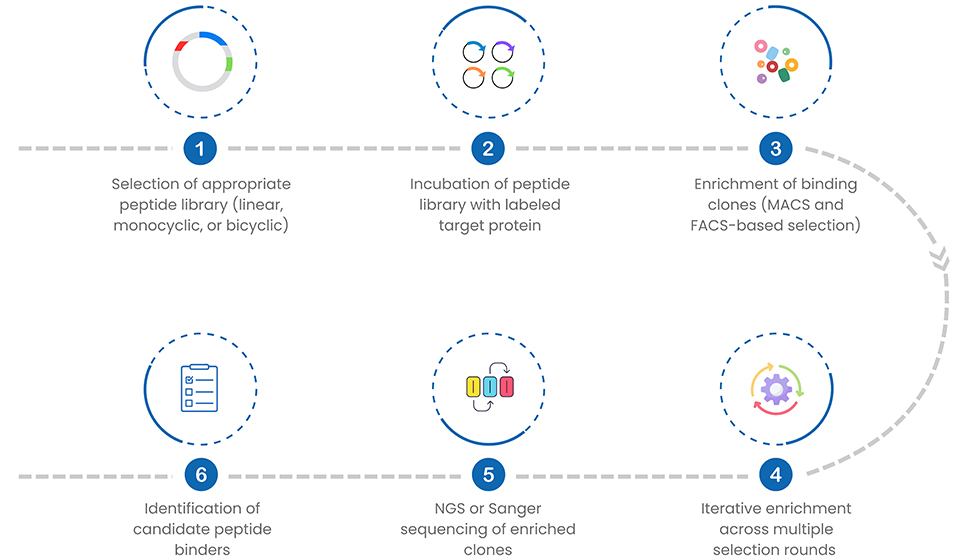
Yeast Display Peptide Screening Workflow

Our peptide discovery workflow integrates yeast display technology with high-throughput screening and sequence analysis.


Yeast Display Peptide Library Screening

Peptide Binder Validation (optional)

To confirm screening results, selected peptide candidates can undergo preliminary validation.

Typical validation steps include:

Peptide synthesis

ELISA-based binding assays

Flow cytometry binding analysis

Competitive binding assays (for masking peptide discovery)


These experiments help confirm target binding and support further development of peptide candidates.

Deliverables

Clients will receive:

Target-binding peptide sequences

Sequence enrichment analysis

Comprehensive screening report

Candidate peptide synthesis (optional)

Preliminary binding validation data(optional)


Optional downstream services include functional characterization.

Typical Project Timeline

Package

Service Step

Deliverables

Timeline

Basic

Library screening

Enriched peptide sequences and screening report

2–3 weeks

Optional

Peptide synthesis

Synthetic peptides (linear or cyclic)

1-3 weeks

Optional

Binder validation

Binding and functional validation data

1–2 weeks

Applications of Yeast Display Peptide Library Screening

Yeast display peptide library screening supports the discovery of peptide ligands for different target recognition and drug development research needs. By screening diverse peptide sequences against selected targets, researchers can identify potential binding candidates for further characterization and optimization. Our peptide library screening service currently focuses on several application areas.

1. Receptor-Targeting Peptide Discovery

Receptor-targeting peptides are designed to recognize specific cell-surface receptors or other target proteins. Yeast display screening can help identify peptide sequences with target-binding potential, providing candidate ligands for receptor recognition studies and targeted delivery research.

The identified peptide candidates can be further synthesized and evaluated to investigate their binding characteristics, target specificity, and suitability for downstream development.

2. Masking Peptide Discovery

Masking peptides are investigated for their ability to interact with selected target regions and influence molecular recognition or ligand binding. Identifying suitable peptide candidates requires screening against the relevant target and evaluating their binding behavior.

Our yeast display peptide library screening service can support masking peptide discovery, with optional competitive binding assays to further investigate interactions between selected peptide candidates and their target systems.

3. Ligand Development for Receptor-Directed Conjugates (RDC)

Receptor-directed conjugates (RDCs) use targeting ligands to recognize selected receptors and support the development of targeted molecular delivery systems. Peptides offer a potential ligand format for this research due to their sequence diversity and customizable molecular structures.

Yeast display screening helps identify receptor-binding peptide candidates that may serve as targeting components in RDC research. Further studies are required to evaluate receptor specificity, internalization behavior, and delivery-related performance.

Key Considerations for Peptide Library Screening Projects

A successful peptide discovery project depends on more than library diversity. Target presentation, peptide structure, screening conditions, and downstream validation all influence the quality and relevance of the identified candidates. Before starting a yeast display peptide library screening project, several factors should be evaluated.

Target Quality and Presentation

The target should be presented in a suitable format that preserves the molecular features relevant to peptide binding. For protein targets, information about the target sequence, construct boundaries, purification status, tags, and structural characteristics can help determine an appropriate screening strategy.

Peptide Library Format

Linear, monocyclic, and bicyclic peptide libraries provide different structural characteristics for ligand discovery. Library selection should consider the intended target, research objectives, and desired peptide properties rather than relying on sequence diversity alone.

Screening Specificity

Screening conditions should be designed to distinguish target-dependent binding signals from nonspecific interactions. Where appropriate, negative controls, reference proteins, or competing ligands can help assess candidate specificity and improve the interpretation of screening results.

Candidate Evaluation

Enrichment signals and sequence recurrence can help prioritize potential peptide binders. However, enrichment during yeast surface display screening does not automatically establish the binding performance of a free synthetic peptide. Selected candidates should undergo additional experimental evaluation when independent binding confirmation is required.

Information Required for a Peptide Screening Project

To evaluate a peptide library screening project and recommend an appropriate discovery strategy, clients are encouraged to provide relevant target and research information before starting the service.

Information Details to Provide Why It Matters
Target Information Target name, protein sequence, structure, or relevant molecular information. Helps assess target suitability and screening feasibility.
Target Format Purified protein, recombinant target, receptor domain, or other available target format. Helps determine target presentation and assay compatibility.
Research Objective Receptor targeting, masking peptide discovery, or RDC ligand development. Defines the desired screening outcome.
Preferred Peptide Format Linear, monocyclic, or bicyclic peptides, if already determined. Supports selection of a suitable premade peptide library.
Validation Requirements Binding confirmation, competitive binding analysis, or other downstream evaluation needs. Helps define optional synthesis and validation services.

If the preferred peptide format or screening strategy has not yet been determined, clients can share their target information and research objectives first. Our team can then discuss suitable library options and potential project requirements.

How Are Peptide Screening Results Evaluated?

Yeast display peptide library screening combines fluorescence-based cell selection with sequence analysis to identify and prioritize potential target-binding peptides. Rather than relying on a single screening signal, candidate evaluation should consider several complementary indicators.

FACS-Based Binding Signal Analysis

Fluorescence-activated cell sorting (FACS) enables the selection of yeast cells displaying peptides that interact with the target under defined experimental conditions. Fluorescence signals provide a quantitative basis for comparing candidate populations during screening.

Sequence Enrichment Analysis

Sequence analysis helps identify peptide candidates that become enriched during the screening process. Comparing enriched sequences can support candidate prioritization and reveal recurring peptide motifs associated with target recognition.

Follow-Up Binding Confirmation

Selected peptide sequences can be synthesized for further evaluation. Depending on project requirements, ELISA-based binding assays, flow cytometry binding analysis, and competitive binding assays can provide additional evidence of target interaction.

Combining screening signals, sequence information, and follow-up experimental data provides a more comprehensive basis for evaluating peptide candidates and selecting sequences for subsequent research.

Frequently Asked Questions About Yeast Display Peptide Library Screening

1. What is a yeast display peptide library screening service?

A yeast display peptide library screening service uses yeast cells to present diverse peptide sequences on their surfaces. These displayed peptides are screened against a selected target, and fluorescence-activated cell sorting (FACS) is used to enrich potential target-binding candidates. Sequence analysis then helps identify peptides for further evaluation.

2. What types of peptide libraries are available for screening?

Our service provides three main premade peptide library formats: linear peptide libraries, monocyclic peptide libraries, and bicyclic peptide libraries. They differ in structural constraints and can support different peptide ligand discovery strategies. The appropriate format depends on the target and research objectives.

3. Does peptide library screening guarantee functional peptide candidates?

No. Initial screening identifies potential target-binding peptide candidates based on experimental selection signals. Binding activity, specificity, and biological function require additional evaluation. Optional peptide synthesis and validation experiments can help characterize selected candidates.

4. Can you provide peptide synthesis and binding validation after screening?

Yes. Peptide synthesis and preliminary binder validation are available as optional downstream services. Depending on project requirements, validation methods may include ELISA-based binding assays, flow cytometry binding analysis, and competitive binding assays for masking peptide research.

5. What information should I provide before starting a screening project?

Clients are encouraged to provide target information, target format, research objectives, and any preferred peptide library format. Details about negative controls, competing ligands, and downstream validation requirements are also helpful for evaluating the project and planning the screening strategy.

6. Does the service include custom peptide library construction?

This service is based on our available premade high-diversity yeast display peptide libraries. If your project requires a newly designed or customized peptide library, please share your sequence design and research requirements so that the feasibility and service scope can be discussed separately.

7. How can I confirm whether a selected peptide binds to my target?

Selected candidates can be synthesized and evaluated using appropriate binding assays. ELISA-based binding assays and flow cytometry analysis can help investigate target interaction, while competitive binding assays may be considered when studying masking peptide candidates. The final validation strategy depends on the target and intended application.

Yeast Display Peptide Library Screening
 

Typical peptide discovery projects can be completed within 3–5 weeks depending on project complexity.
Why Choose Our Yeast Display Peptide Screening Platform
Premade High-Diversity Libraries
Our ready-to-use peptide libraries eliminate the need for library construction, significantly reducing project timelines.
Multiple Peptide Formats
We offer linear, monocyclic, and bicyclic peptide libraries to support different discovery strategies.
Quantitative FACS Screening
Yeast display enables precise quantitative screening using fluorescence-activated cell sorting.
Experienced Discovery Team
Our scientists have extensive experience in yeast display screening and peptide ligand discovery.
See Our Wide Array of NANOBODY Services
Immunogen Design & Production
Camelid Immunization
Phage Display Nanobody Discovery
Functional Characterization
Yeast Display Nanobody Discovery
Premade Library Screening
Yeast Display Peptide Library Screening
Nanobody Discovery for ADC Development
Yeast Display Nanobody Discovery
Premade Library Screening
Yeast Display Peptide Library Screening
Nanobody Discovery for ADC Development
Related Services
Request a Quote