Protein research teams often need a reliable binder before they can develop an assay, diagnostic test, imaging probe, or purification method. A Premade Nanobody Library Screening Service provides a practical route to this goal by screening an existing VHH library against a target antigen. This approach can reduce animal immunization work, shorten early discovery, and support a premade nanobody library screening service for conserved antigens when the target has limited sequence variation. For many projects, the key question is not simply whether a nanobody can bind, but whether the selected clone has the affinity, specificity, stability, and expression profile needed for the final application.
Suggested image: When Premade Libraries Work Better for Conserved Antigens
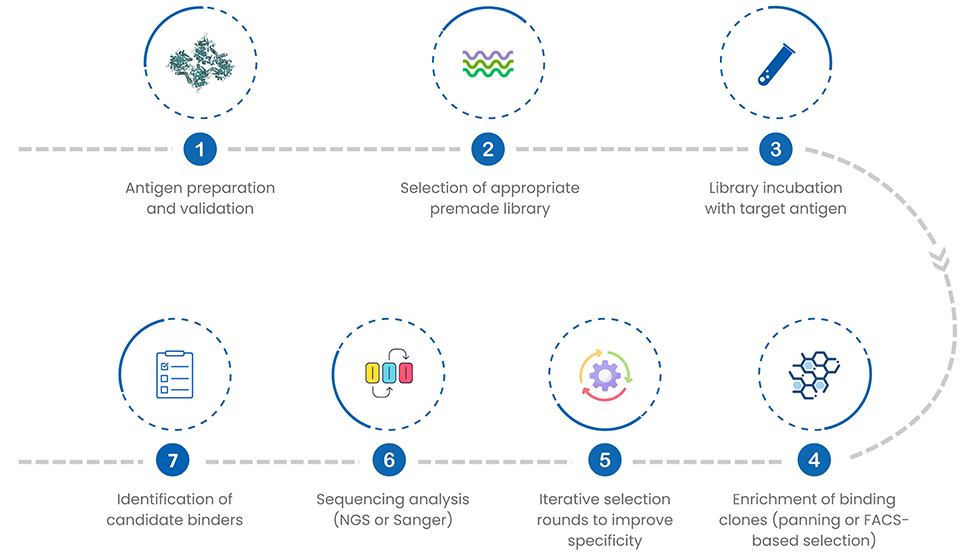
What Is a Premade Nanobody Library Screening Service?
A Premade Nanobody Library Screening Service is a contract research workflow that searches a ready-made collection of nanobody genes or displayed nanobody particles for clones that recognize a selected antigen. The most common format is a VHH, also called a single-domain antibody or nanobody. VHHs originate from the variable domain of camelid heavy-chain antibodies and generally have a molecular mass of about 12–15 kDa, which is much smaller than a conventional IgG of roughly 150 kDa.
In a typical phage display library, each phage presents a nanobody on its surface while carrying the DNA sequence that encodes it. Researchers expose the library to an immobilized or solution-phase antigen, wash away weak or non-specific binders, elute retained particles, and amplify the recovered DNA. Repeated selection rounds enrich clones with stronger or more selective binding. The final candidates are expressed as soluble proteins and tested in assays such as ELISA, biolayer interferometry, surface plasmon resonance, flow cytometry, or Western blotting.
The term premade library means that the library has already been constructed before the client project begins. It may be immune, naïve, synthetic, or semi-synthetic. Each type has a different discovery profile:
- Immune libraries: generated after immunization and often enriched for binders to the immunizing antigen.
- Naïve libraries: built from antibody sequences collected without target-specific immunization and useful for broad target coverage.
- Synthetic libraries: designed with controlled framework sequences and diversified complementarity-determining regions, or CDRs.
- Semi-synthetic libraries: combine natural frameworks with designed sequence diversity to balance folding and binding potential.
Nanobody structure is important to the screening decision. The antigen-contacting CDR3 loop can extend into grooves or enzyme pockets that are difficult for larger antibodies to reach. However, a small size does not automatically guarantee high affinity, strong specificity, or good developability. These properties must be measured after selection.
When Is a Premade Nanobody Library Screening Service the Right Choice?
A premade library is often useful when the antigen is conserved across species, difficult to use for immunization, or needed within a short research schedule. It can also be suitable when the client wants to avoid generating a new immune library for every target.
Conserved antigens require special attention. If a target protein has similar sequences in the host species and the intended test system, immunization may produce a weak immune response or antibodies that recognize only a narrow form of the protein. A synthetic or naïve library can provide sequence diversity without depending on a strong host immune response. This does not remove the need for careful antigen design. The target should still be correctly folded, sufficiently pure, and presented in a form that represents the final assay.
A premade library may be a good fit when:
- The project requires a binder to a recombinant protein, peptide, cell-surface marker, or toxin.
- The target is conserved and immunization is unlikely to provide useful diversity.
- The antigen is toxic, unstable, poorly immunogenic, or difficult to administer.
- The team needs several independent clones for epitope mapping or assay development.
- The final product may benefit from the small size and modular design of a VHH.
- The project needs a rapid nanobody discovery screening service with a defined selection and validation workflow.
A custom immune library may be preferable when the target has unusual conformational states, requires a highly tailored immune response, or demands extensive affinity maturation from the beginning. The correct choice depends on antigen quality, target format, timeline, budget, and the required validation depth.
How the Premade Nanobody Library Screening Process Works
1. Target and project review
The process begins with a technical review of the target. Important information includes the protein sequence, species, domain boundaries, tags, oligomeric state, purification method, buffer, concentration, and intended application. The service provider should also ask whether the target is soluble, membrane-associated, post-translationally modified, or sensitive to immobilization.
Clients should explain the final use at this stage. A clone for ELISA may not work in flow cytometry. A binder selected against a denatured protein may fail to recognize the native conformation on a cell. Defining the final assay early helps the screening team choose the right antigen presentation and counter-selection strategy.
2. Antigen quality control
Antigen quality affects every later result. A service provider may review purity by SDS-PAGE, identity by mass spectrometry or sequence confirmation, aggregation by size-exclusion chromatography, and concentration by UV absorbance or another validated method. If the antigen forms aggregates, the library may enrich clones against exposed hydrophobic regions instead of the intended epitope.
For membrane proteins, common options include purified detergent-solubilized protein, lipid nanoparticles, proteoliposomes, virus-like particles, or whole cells. For a conserved enzyme, the native oligomeric state and cofactor conditions may be important. For a peptide target, adding a carrier or including a neighboring sequence can improve presentation.
3. Library selection and panning
During phage display panning, the library is incubated with the antigen. Non-binding particles are removed by washing, and retained particles are eluted and amplified. Many projects use approximately three to five selection rounds, although the exact number depends on library complexity, antigen behavior, background binding, and enrichment data.
Selection pressure can be increased by reducing antigen concentration, extending washing, adding soluble competitor, or using a negative selection step. Counter-selection may remove clones that bind a purification tag, carrier protein, plastic surface, unrelated proteins, or a closely related off-target. For a conserved antigen, testing orthologs or related proteins can help identify cross-reactive and species-selective clones.
4. Clone recovery and sequence analysis
After enrichment, individual clones are isolated and their VHH genes are sequenced. Sequence analysis can identify unique CDR patterns, repeated clones, framework liabilities, stop codons, and possible aggregation-prone motifs. Repeated recovery of the same sequence may indicate strong enrichment, but it does not prove that the clone has the best affinity or specificity.
Sequence clustering is useful because different DNA sequences can encode related binding solutions. A service provider may select a panel of genetically distinct clones rather than testing only the most frequent sequence. This increases the chance of finding candidates with different epitopes, expression behavior, and developability profiles.
5. Soluble expression and primary screening
Selected VHH genes are commonly expressed in a microbial host such as Escherichia coli. The purified proteins are then tested in a primary binding assay. ELISA is useful for a first screen, but it should not be the only evidence. ELISA signal can be affected by antigen coating, avidity, protein aggregation, and plate-surface interactions.
A stronger workflow combines ELISA with at least one solution-based or kinetic method. Biolayer interferometry and surface plasmon resonance can measure association and dissociation behavior. The dissociation constant, or KD, is commonly used to describe affinity. Lower KD values indicate tighter binding under the tested conditions, but the result depends on assay format, temperature, immobilization, and analyte quality.
6. Specificity and application testing
Specificity testing should match the intended use. A diagnostic clone may be tested against related proteins, serum components, common interferents, and target-negative samples. A cell-binding nanobody may be evaluated on target-positive and target-negative cell lines by flow cytometry. A research reagent for Western blotting should be tested against reduced and denatured antigen, while an imaging probe requires testing in the presence of the planned label or conjugation chemistry.
Useful performance measurements include the percentage of target-positive cells detected, signal-to-background ratio, limit of detection, recovery after repeated freeze-thaw cycles, thermal stability, and expression yield. Reporting these values is more informative than describing a clone as “excellent” or “highly stable.”
7. Lead selection and optional optimization
Lead selection should balance affinity with specificity, expression, stability, and application performance. A clone with a KD of 2 nM may be less useful than a 10 nM clone if the first candidate aggregates or loses binding in the required buffer.
If the initial candidates do not meet the project criteria, possible next steps include CDR mutagenesis, error-prone PCR, DNA shuffling, multivalent formatting, framework engineering, or site-specific conjugation. These steps should be chosen based on the failure mode. For example, affinity maturation addresses binding strength, while framework engineering may address expression or stability.
Applications of Premade Nanobody Library Screening Services
Diagnostics and immunoassays
Nanobodies can be used as capture or detection reagents in ELISA, lateral-flow tests, electrochemical biosensors, and multiplex assays. Their compact structure may support dense surface coating and access to epitopes near steric barriers. Diagnostic development still requires matrix testing, cross-reactivity studies, analytical sensitivity measurements, and clinical validation.
Cell biology and flow cytometry
VHHs can recognize extracellular markers or intracellular targets after cell permeabilization. For cell-surface studies, screening against native cells or membrane-like antigen formats may provide more relevant binders than screening only against a purified domain. Fluorescently labeled nanobodies can also support receptor internalization and trafficking studies.
Structural biology and cryo-electron microscopy
Nanobodies can stabilize flexible proteins and help increase the molecular mass of small targets for structural analysis. A selected VHH may lock an enzyme in a defined conformational state or improve particle alignment. The final value depends on complex formation, sample homogeneity, affinity, and whether the nanobody changes the target conformation.
Protein purification and research reagents
A nanobody can be immobilized as an affinity ligand for target capture. This may be useful when conventional antibodies show batch variation or poor performance under the required elution conditions. The ligand must be tested for binding capacity, regeneration tolerance, leakage, and target recovery.
Imaging and targeted delivery research
Because VHHs are small, they can be connected to fluorescent dyes, radionuclide chelators, nanoparticles, or drug-delivery systems. Their short tissue-retention profile may be useful for some imaging applications, but rapid renal clearance and possible immunogenicity must be assessed in the relevant model.
Advantages and Limitations of a Premade Nanobody Library Screening Service
Key advantages
- Reduced early development work: the library is prepared before the project starts, so the team does not need to build a target-specific immune library first.
- Access to compact binders: VHHs are about one-tenth the molecular mass of a full IgG, which can help with tissue access and fusion-protein design.
- Multiple clone options: screening can produce a panel of sequences for affinity, epitope, and application comparison.
- Flexible engineering: VHHs can be fused to Fc domains, enzymes, fluorescent proteins, tags, or other nanobodies.
- Potential for conserved targets: naïve and synthetic libraries can provide alternatives when immunization is difficult.
Important limitations
- A binder selected against a recombinant antigen may not recognize the native target on a cell.
- High ELISA signal does not prove strong solution-phase affinity.
- Some clones express poorly or aggregate after purification.
- Cross-reactivity must be measured rather than assumed from sequence data.
- A premade library cannot replace a well-designed antigen and properly controlled validation assays.
How to Choose a Premade Nanobody Library Screening Service Provider
Before starting, ask the provider for clear information about the library type, estimated diversity, display format, selection rounds, antigen requirements, sequencing depth, and reporting format. The provider should explain which results are included in the base package and which require additional fees.
Important questions include:
- Is the library naïve, immune, synthetic, or semi-synthetic?
- What is the approximate library size and how is quality controlled?
- Can the provider screen soluble proteins, peptides, cells, or membrane proteins?
- Are negative selection and off-target testing included?
- How many unique clones will be sequenced?
- Will soluble expression and purification be performed before delivery?
- Which affinity and specificity measurements are reported?
- Are raw sequence data, chromatograms, kinetic curves, and assay protocols provided?
- Who owns the resulting sequences and intellectual property?
- Can the provider support affinity maturation or conjugation after lead selection?
A strong provider should connect discovery results to the final application. For example, a clone intended for a lateral-flow assay should be tested in the relevant sample matrix, not only on a purified plate-coated antigen.
Scientific Evidence Supporting Nanobody Discovery
The original description of heavy-chain antibodies in camelids was reported by Hamers-Casterman and colleagues in Nature in 1993. Later reviews described the structure, production, engineering, and applications of VHH domains. These publications support the biological basis for using single-domain antibody fragments, while current project decisions still require target-specific experimental data.
- Hamers-Casterman et al., “Naturally occurring antibodies devoid of light chains,” Nature, 1993. DOI: .
- Muyldermans, “Nanobodies: Natural Single-Domain Antibodies,” Annual Review of Biochemistry, 2013. DOI: .
- RCSB Protein Data Bank, educational resources on antibody and protein structures: .
- IMGT, the international ImMunoGeneTics information system, for antibody sequence and numbering resources: .
These sources explain why VHHs are structurally distinct from conventional antibodies. They do not guarantee a particular project outcome. Claims about affinity, yield, specificity, stability, or diagnostic performance should be based on the provider’s measured data and the client’s target-specific assays.
Frequently Asked Questions About Premade Nanobody Library Screening
How long does screening usually take?
The timeline depends on antigen readiness, library format, selection rounds, sequencing, expression, and validation depth. A basic discovery project may take several weeks, while a project involving cell-based screening, kinetic characterization, optimization, and application testing may take longer. Request a stage-by-stage schedule rather than relying on a single total estimate.
What antigen amount is required?
The amount varies with the library format and selection design. Soluble purified proteins often require less material than whole-cell or membrane-protein projects because the antigen can be reused across multiple rounds. The provider should calculate the amount based on concentration, molecular mass, immobilization method, and planned controls.
Can a premade library produce nanobodies against conserved proteins?
Yes, it can provide an alternative route when immunization may be difficult. However, the screening design should include the native target format and related proteins when cross-reactivity matters. A conserved sequence may produce a binder that recognizes several species, which can be useful or undesirable depending on the application.
What affinity should a useful nanobody have?
There is no universal cutoff. A research assay may work with a weaker binder if the target is abundant and the background is low. A therapeutic or low-abundance detection application may require tighter binding and a slow dissociation rate. Affinity should be judged together with specificity, stability, expression, and assay performance.
Is ELISA enough to confirm a positive nanobody?
No. ELISA is a valuable screening tool, but it can produce misleading results because of coating artifacts and avidity. Confirmatory testing should use a method suited to the application, such as biolayer interferometry, surface plasmon resonance, flow cytometry, Western blotting, immunoprecipitation, or a functional assay.
Can nanobodies be used in human applications?
They can be developed for human research, diagnostic, imaging, or therapeutic applications, but additional work is required. This may include humanization or de-immunization, pharmacokinetic studies, toxicity testing, production under the required quality system, and regulatory evaluation. Research-grade screening results are not equivalent to clinical approval.
What should I prepare before contacting 阿帕克?
Prepare the target sequence, antigen format, available quantity, purity data, intended application, target species, known off-targets, preferred timeline, and required deliverables. Asking 阿帕克 for a written screening plan can help clarify whether a premade library, a custom library, or a combined strategy is most suitable.
Next Steps for Starting a Premade Nanobody Library Screening Service
Begin by defining the final assay and the evidence required for a successful clone. Then confirm antigen quality, select the most suitable library type, and agree on selection controls before screening starts. The project plan should include clone sequencing, soluble expression, affinity testing, specificity testing, and application-level validation.
For teams comparing providers or preparing a first project, the next useful step is to read the user guide, review the technical specifications, and request a target-specific feasibility assessment. A carefully designed custom nanobody validation and screening service can then turn an initial binding signal into a reproducible research reagent. Contact 阿帕克 to discuss the target, required controls, reporting package, and follow-up optimization options.



 Yeast Display VHH Discovery Service
 Immunogen Design & Production
 Premade Library Screening
 Phage Display Nanobody Discovery Service
 Animal Immunization
 Yeast Display Peptide Library Screening

 Nanobody Discovery for ADC
 Nanobody Discovery for Membrane Targets
 Nanobody Discovery for Cell Therapy
 TCR-Mimic Nanobody Discovery


 Antibody Affinity Maturation Service
 Nanobody Humanization Service