Best Immunogen Strategies for Poorly Immunogenic Targets
Nov.13,2026
Share:
Nanobody projects often fail before screening begins because the antigen is unstable, poorly immunogenic, or presented in the wrong form. An Immunogen Preparation Service for Nanobody Discovery helps researchers convert a difficult target into a defined, quality-tested immunogen. The workflow may include custom immunogen preparation for nanobody discovery, immunogen design for poorly immunogenic targets, and a recombinant immunogen service for VHH antibody discovery. These steps reduce avoidable delays in camelid immunization, phage display, and downstream affinity testing.
For membrane proteins, short peptides, toxins, enzymes, and multiprotein complexes, the key question is not simply whether an antigen can be produced. The question is whether it preserves the structure and epitope needed to generate useful VHH antibodies. A planned immunogen strategy addresses that problem before animals are immunized.
Best Immunogen Strategies for Poorly Immunogenic Targets should match the antigen format to the target’s structure, stability, and intended epitope.
What Is an Immunogen Preparation Service for Nanobody Discovery?
An Immunogen Preparation Service for Nanobody Discovery is a research service that designs, produces, purifies, characterizes, and delivers an antigen for nanobody generation. The material may be a recombinant protein, peptide conjugate, virus-like particle, protein complex, membrane-protein preparation, or a mixture of complementary antigen formats.
In this context, an immunogen is the material used to stimulate an immune response. An antigen is the molecule recognized by an antibody or immune receptor. The two terms are related but not identical: a molecule may bind an antibody but produce a weak immune response. Immunogenicity describes the ability to induce an immune response, while epitope means the specific region recognized by an antibody.
Nanobodies are single-domain antibody fragments, often called VHH domains, derived from camelid heavy-chain antibodies. Their compact binding domain is commonly about 12–15 kDa, compared with approximately 150 kDa for a conventional IgG molecule. The small size can support access to recessed binding sites and improve tissue penetration in some research settings, but the final result still depends on antigen quality and screening design.
Why Immunogen Preparation Matters in Nanobody Discovery
A poorly prepared immunogen can create several problems:
Incorrect folding: antibodies may bind denatured protein instead of the native target.
Low immune exposure: a small peptide or highly conserved protein may produce a limited response.
Aggregation: particles can mask useful epitopes and complicate dose consistency.
Host-protein contamination: antibodies may be generated against expression-system impurities.
Loss of membrane-protein structure: detergent or purification conditions may destroy conformational epitopes.
Unwanted tag recognition: anti-His-tag or anti-carrier antibodies can dominate screening results.
These risks directly affect library diversity, hit rate, specificity, and later validation. In a phage-display workflow, a large number of clones does not guarantee useful binders. The antigen must support positive selection for the intended target and negative selection against tags, carriers, paralogs, or unrelated proteins.
Published research supports the value of camelid single-domain antibodies as a distinct antibody format. Hamers-Casterman and colleagues first described heavy-chain antibodies in camelids in Nature in 1993. A detailed review by Muyldermans in Annual Review of Biochemistry explains VHH structure, antigen recognition, and nanobody development. These sources are useful starting points for planning a discovery project:
Best Immunogen Strategies for Poorly Immunogenic Targets
Poorly immunogenic targets need a design strategy rather than a larger dose alone. The correct approach depends on molecular size, stability, conservation, expression level, and the epitope that the final nanobody must recognize.
1. Use a full-length recombinant protein when structure is stable
A purified full-length protein can expose multiple epitopes and support broad VHH generation. This format is often suitable for soluble enzymes, extracellular domains, and stable binding proteins. The design should define the construct boundaries, signal peptide, purification tag, cleavage site, and expected oligomeric state.
For quality control, common project specifications include a dominant band at the expected molecular weight by SDS-PAGE, a defined purity threshold, and a monodisperse profile by size-exclusion chromatography. A practical starting specification may be at least 80–90% purity for exploratory immunization, with higher purity preferred when the target is small or the contaminant profile is complex. Final limits should be agreed after pilot production.
2. Present short peptides with a carrier or multivalent scaffold
Short peptides below about 10–15 amino acids may not maintain a stable three-dimensional structure and may be weakly immunogenic on their own. Conjugation to carriers such as KLH or BSA can increase molecular size and immune presentation. Multiple copies of the peptide on a scaffold can also increase avidity during immunization.
The carrier must be included in the screening plan. If the carrier is used only for immunization, screening against the free peptide and an unrelated carrier control can help remove carrier-reactive clones. Peptide orientation, terminal protection, linker length, and conjugation chemistry should reflect the intended epitope.
3. Build a multivalent or particulate antigen
Virus-like particles, liposomes, nanoparticles, and protein scaffolds can display repeated copies of a weak antigen. Repetition can increase B-cell receptor cross-linking and improve immune recognition. This approach is useful for short peptides, small domains, and antigens that need a defined surface presentation.
The formulation should be checked for particle size, aggregation, loading ratio, and batch stability. Dynamic light scattering can provide a hydrodynamic diameter and polydispersity estimate, while transmission electron microscopy may help confirm particle morphology.
4. Preserve membrane-protein conformation
Membrane proteins frequently lose their native structure after detergent extraction. Options include detergent-stabilized protein, liposomes, nanodiscs, styrene–maleic acid lipid particles, or cell-based immunization. The choice should match the intended binding assay. If the final nanobody must recognize the receptor on live cells, a cell-surface or membrane-mimetic antigen may be more predictive than a denatured purified domain.
For membrane targets, orthogonal testing is important. A useful panel may include purified protein, target-positive cells, target-negative cells, and a related protein. This helps distinguish conformation-specific binding from nonspecific membrane or tag binding.
5. Combine antigen formats in a staged immunization plan
One format does not need to be used for every immunization. A project may begin with a purified recombinant protein, use a stabilized complex for boosting, and finish with a cell-based or native-like antigen. This strategy can broaden the response while maintaining selection pressure toward the desired structure.
The sequence should be planned with the animal facility and discovery team. Changes in carrier, formulation, or antigen format can alter the immune response, so each material should be traceable by batch, concentration, formulation, and storage condition.
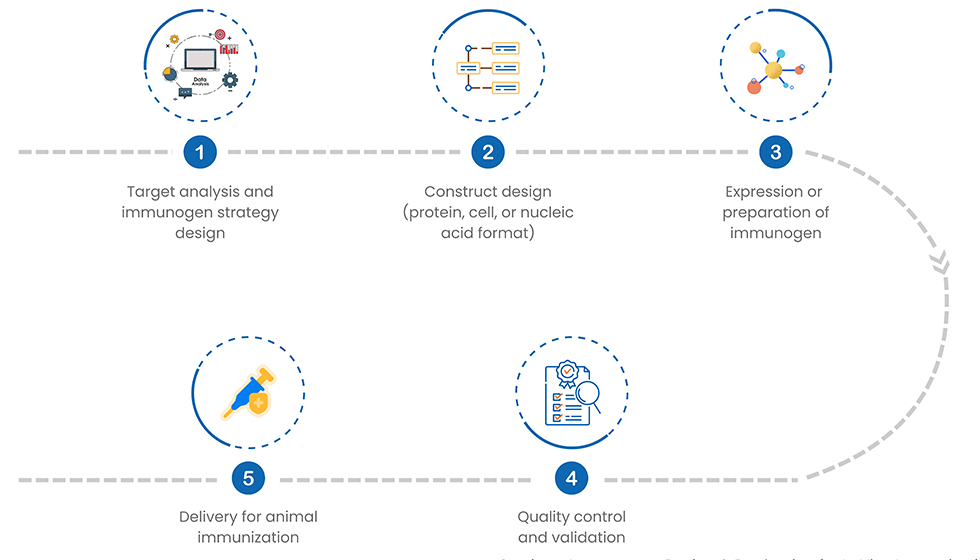
Step-by-Step Immunogen Preparation Workflow
Step 1: Define the discovery objective
Before expression begins, document what the nanobody must do. Examples include:
Bind the native extracellular domain.
Recognize a disease-associated mutation.
Block a ligand–receptor interaction.
Detect the target in ELISA, western blot, immunofluorescence, or flow cytometry.
Bind a catalytic or allosteric site.
Distinguish one paralog from another.
The intended application determines whether the immunogen should be folded, membrane-bound, complexed with a ligand, or presented as a peptide. It also determines which negative controls will be needed during panning and validation.
Step 2: Analyze the target sequence and structure
A professional design review commonly includes sequence alignment, domain boundaries, predicted disorder, transmembrane regions, glycosylation sites, oligomerization regions, and available structures from the Protein Data Bank. Conservation analysis can identify regions likely to produce cross-reactive antibodies. Structure prediction may help select a stable domain when a full-length protein is difficult to express.
For a human target, the percentage of sequence identity to the immunization host and the presence of exposed non-self regions should be considered. A highly conserved protein may require a native complex, a modified epitope, or a peptide that exposes a less-conserved surface.
Step 3: Select the expression system
Target type
Common expression option
Main consideration
Small soluble bacterial protein
E. coli
Fast production, but inclusion bodies and missing post-translational modifications may occur.
Disulfide-rich or secreted protein
Mammalian or insect cells
Improved folding and secretion for many complex proteins.
Glycoprotein or extracellular receptor
Mammalian cells
More suitable for native-like glycosylation and disulfide formation.
Multipass membrane protein
Insect, mammalian, cell-free, or membrane-mimetic systems
Stability and native conformation are the primary constraints.
Step 4: Produce and purify the immunogen
Typical purification stages include affinity capture, tag cleavage when needed, ion-exchange or mixed-mode polishing, and size-exclusion chromatography. The final buffer should support stability and be compatible with immunization. Avoid residual imidazole, high detergent levels, reactive reducing agents, or preservatives that may interfere with the planned use.
For peptide projects, analytical HPLC and mass spectrometry can confirm identity and purity. For recombinant proteins, SDS-PAGE, SEC, western blot, intact-mass analysis, and endotoxin testing may be appropriate. The required tests should be selected according to the host species, route of administration, and downstream assay.
Step 5: Confirm identity, concentration, and stability
At minimum, the service provider should report the construct identity, batch number, concentration method, buffer, storage temperature, freeze–thaw history, and recommended working concentration. A short-term stability study at 2–8°C and a longer storage study at −80°C can reveal precipitation or degradation before immunization.
For protein immunogens, useful data may include:
Purity by reducing and non-reducing SDS-PAGE.
Monomer or oligomer distribution by SEC.
Identity by mass spectrometry or immunoblotting.
Concentration by A280, BCA, or another validated method.
Endotoxin level, reported in EU per milligram or EU per dose.
Binding activity in ELISA, biolayer interferometry, surface plasmon resonance, or a cell-based assay.
There is no universal purity or endotoxin limit for every nanobody project. A research immunogen and a material intended for in vivo therapeutic studies have different requirements. The acceptance criteria should be written before production rather than changed after an unsuccessful immunization.
Quality Control Parameters to Request
A complete certificate of analysis should make the batch easy to evaluate. Ask for the following information:
Parameter
Why it matters
Useful reporting format
Identity
Confirms that the delivered material is the intended target.
Construct map, sequence, mass spectrometry, or target-specific assay.
Purity
Reduces immune responses to host proteins and contaminants.
Percentage by SDS-PAGE, SEC, or HPLC.
Aggregation
Aggregates may alter dosing and epitope presentation.
SEC profile, DLS size, or visible-particle observation.
Endotoxin
Supports safer and more consistent animal work.
EU/mg or EU/dose using an LAL or recombinant factor C method.
Functional activity
Shows that the target still presents a relevant binding site.
EC50, KD, signal-to-background ratio, or relative activity.
Stability
Prevents degradation during shipment and storage.
Time, temperature, buffer, and post-storage test result.
For binding measurements, surface plasmon resonance and biolayer interferometry can report association and dissociation rates as well as the apparent equilibrium dissociation constant, KD. A lower KD generally indicates stronger binding in that assay, but affinity alone does not prove specificity, blocking activity, or performance in cells.
How the Prepared Immunogen Supports Nanobody Discovery
After immunization, lymphocyte material can be used to build an immune VHH library. The library may then be screened by phage display, yeast display, ribosome display, or another platform. A well-designed immunogen supports several selection stages:
Positive selection: enrich clones that bind the target.
Negative selection: remove clones that bind tags, carriers, blocking reagents, host-cell proteins, or related proteins.
Counter-screening: test target-negative cells or unrelated antigens.
Sequence analysis: group clones by CDR3 and framework sequence.
Recombinant expression: produce individual VHH candidates.
Functional testing: measure affinity, specificity, stability, and biological activity.
For a cell-surface target, purified-protein panning alone may enrich clones that fail to bind the native receptor. Conversely, cell-based selection alone can produce binders to unrelated surface molecules. Combining purified antigen, target-positive cells, target-negative cells, and related proteins creates a stronger evidence chain.
Application Scenarios for Immunogen Preparation Service for Nanobody Discovery
Drug discovery and therapeutic research
Nanobodies can be explored as blocking agents, receptor modulators, targeted delivery components, or imaging ligands. The immunogen should preserve the binding site related to the desired mechanism. For a blocking project, the antigen may need to be presented with its natural ligand or in a receptor conformation that exposes the functional interface.
Diagnostics and assay development
Diagnostic assays often need high specificity, stable reagents, and consistent lot performance. A peptide, domain, or full-length protein can be selected according to whether the assay detects total protein, a cleavage product, a pathogen antigen, or a disease-specific modification.
Structural biology and cryo-electron microscopy
Nanobodies can stabilize specific conformations and increase the effective size of small protein complexes. In this case, the immunogen should favor the state required for structural analysis, such as an active receptor, ligand-bound complex, or transient enzyme conformation.
Cell biology and imaging
For flow cytometry, immunofluorescence, and live-cell labeling, the antigen must reflect the target’s native surface presentation. Cell-based immunogens or membrane-mimetic preparations may be more suitable than denatured protein. Screening should include live and fixed cells if both applications are planned.
Pathogen and vaccine research
Viral and bacterial targets may contain repeated, variable, or conformational epitopes. A recombinant domain, stabilized prefusion protein, peptide, or virus-like particle can be selected based on the desired breadth and specificity. Sequence variation among strains should be included in the antigen and counter-screening plan.
Advantages of a Professionally Managed Immunogen Preparation Service
Lower design risk: sequence, structure, expression, and assay requirements are reviewed before production.
Traceable material: batch records connect each antigen to its construct, purification method, and quality data.
Better assay alignment: the immunogen format is selected for the final application rather than for production speed alone.
Fewer repeat experiments: early checks for aggregation, endotoxin, and binding activity can identify problems before animal work.
Flexible formats: one project can include recombinant proteins, peptides, cells, liposomes, nanodiscs, or complexes.
Support for difficult targets: poorly soluble, highly conserved, low-molecular-weight, and membrane-associated targets can receive a tailored plan.
The main benefit is process control. A project team can compare the planned antigen with the intended epitope, assay, and screening method before committing to a full discovery campaign.
How to Choose an Immunogen Preparation Provider
Before ordering, ask the provider these practical questions:
Can the team design multiple constructs if the first expression attempt fails?
Which expression systems are available for secreted, membrane, and disulfide-rich targets?
Will the provider report SEC, SDS-PAGE, endotoxin, identity, and functional binding data?
Can the antigen be supplied in a native-like format such as a nanodisc or cell presentation?
How are tags and carriers controlled during downstream screening?
What quantity is required for immunization, ELISA, panning, and validation?
How are samples labeled, shipped, stored, and replaced if degradation occurs?
Can the service be connected to camelid immunization, VHH library construction, and nanobody screening?
Provide the target sequence, species, domain boundaries, known structures, desired epitope, intended assay, expression history, and any known stability problems. This information allows the provider to recommend a primary format and at least one backup strategy.
Suggested Project Timeline and Deliverables
The exact timeline depends on construct complexity and expression yield. A typical service plan may include:
Design review: target analysis, construct selection, and risk assessment.
Pilot expression: small-scale testing of one or more constructs.
Analytical testing: identity, purity, solubility, aggregation, and preliminary activity.
Scale-up: production of the selected construct or antigen format.
Final QC: certificate of analysis and storage instructions.
Discovery handoff: immunization and screening recommendations based on the antigen data.
Do not judge the project only by the number of milligrams delivered. A smaller amount of correctly folded, monodisperse, active antigen can be more useful than a larger amount of aggregated or denatured material.
FAQ About Immunogen Preparation Service for Nanobody Discovery
What amount of antigen is needed?
The amount depends on the animal protocol, number of immunizations, antigen format, and whether the same material will be used for ELISA or panning. The provider should calculate the required amount from the planned dose, number of animals, number of boosts, and analytical reserve.
Is a His-tag acceptable for nanobody immunization?
A His-tag can simplify purification, but it may generate tag-reactive clones. If the tag remains on the immunogen, include tag-only and unrelated His-tagged proteins during screening. Tag cleavage or use of a second purification format may reduce this risk.
What is the best immunogen for a membrane protein?
There is no universal best format. Detergent-stabilized protein, nanodiscs, liposomes, virus-like particles, and target-positive cells are possible choices. The best option is the one that preserves the epitope required in the final live-cell or biochemical assay.
Can a peptide generate a nanobody?
Yes, but a short peptide may need carrier conjugation, multivalent display, or a scaffold to improve presentation. If the desired epitope depends on a three-dimensional fold, a recombinant domain or native-like complex is usually more appropriate than a linear peptide.
How can I reduce antibodies against the carrier protein?
Use carrier controls during ELISA and panning, screen against the free target when possible, and consider changing the carrier between immunization and screening. The final strategy should be selected with the discovery team before immunization.
Does high affinity guarantee a useful nanobody?
No. A nanobody may show a low apparent KD but fail to recognize the native target, block function, remain stable, or avoid cross-reactivity. Candidate selection should combine affinity, specificity, expression yield, thermal stability, aggregation behavior, and application-specific activity.
Can 阿帕克 support a difficult-target project?
阿帕克 can be considered when a project needs coordinated antigen design, recombinant production, quality testing, or a tailored plan for poorly immunogenic targets. Share the target sequence and intended application to request a feasibility review, recommended immunogen format, and preliminary QC plan.
Next Steps for Your Nanobody Project
Start by defining the intended nanobody function, target form, required epitope, and final assay. Then prepare the sequence and structure information for a design review. Ask for a written proposal that lists the construct, expression system, antigen format, purification method, QC tests, acceptance criteria, storage conditions, and backup plan. A structured Immunogen Preparation Service for Nanobody Discovery can improve the connection between antigen preparation and downstream VHH screening. For teams comparing custom immunogen preparation for nanobody discovery providers, the next practical step is to send the target information to 阿帕克 and request a feasibility assessment.
Previous:
How to Improve Soluble Yield in Nanobody Production
Next:
What Affinity Range Works Best for CAR-T Target Binders



 Yeast Display VHH Discovery Service
 Immunogen Design & Production
 Premade Library Screening
 Phage Display Nanobody Discovery Service
 Animal Immunization
 Yeast Display Peptide Library Screening

 Nanobody Discovery for ADC
 Nanobody Discovery for Membrane Targets
 Nanobody Discovery for Cell Therapy
 TCR-Mimic Nanobody Discovery


 Antibody Affinity Maturation Service
 Nanobody Humanization Service