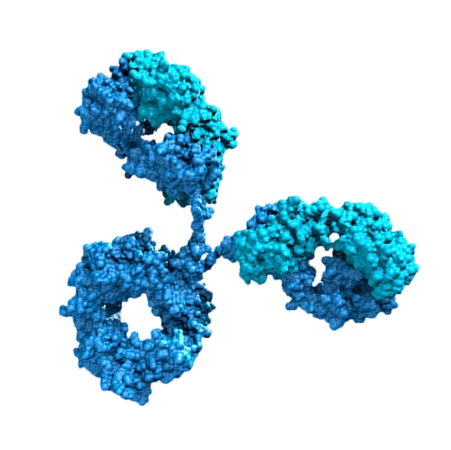
.
TCR-mimic (TCRm) binders recognize peptide-MHC (pMHC) complexes in a manner similar to T-cell receptors, enabling the targeting of intracellular-derived antigens that are inaccessible to conventional antibodies.
Nanobodies provide unique advantages for TCRm applications due to their compact structure, conformational flexibility, and ability to access recessed or structurally restricted epitopes.
Because peptide-MHC complexes often differ by only a few amino acids, TCRm discovery requires exceptional specificity and precise discrimination between closely related epitopes. Off-target recognition remains one of the primary challenges in TCRm development.
To support high-specificity pMHC targeting, our discovery workflows integrate specialized antigen presentation strategies, high-stringency screening approaches, and quantitative display technologies to enable efficient identification of TCR-mimic nanobody candidates.
TCR-mimic discovery requires binders capable of recognizing highly specific peptide-MHC conformations while minimizing cross-reactivity. Nanobodies are particularly suitable for this application due to several unique properties.
Recognition of Conformational Epitopes
The compact VHH structure enables access to structurally restricted peptide-MHC surfaces.
High Specificity Potential
Nanobody-based screening strategies can support stringent selection against closely related pMHC complexes.
Excellent Engineering Flexibility
Suitable for TCRm-CAR, bispecific molecules, and targeted delivery applications.

TCRm discovery presents unique technical challenges compared with conventional antibody discovery.
High pMHC Similarity
Closely related peptide-MHC complexes require extremely selective binders.
Limited Epitope Accessibility
Peptide epitopes are partially buried within MHC grooves.
Off-Target Binding Risk
Cross-reactivity with unrelated peptide-MHC complexes must be minimized.
Functional Specificity Requirement
Binders must recognize physiologically relevant pMHC conformations on cell surfaces.
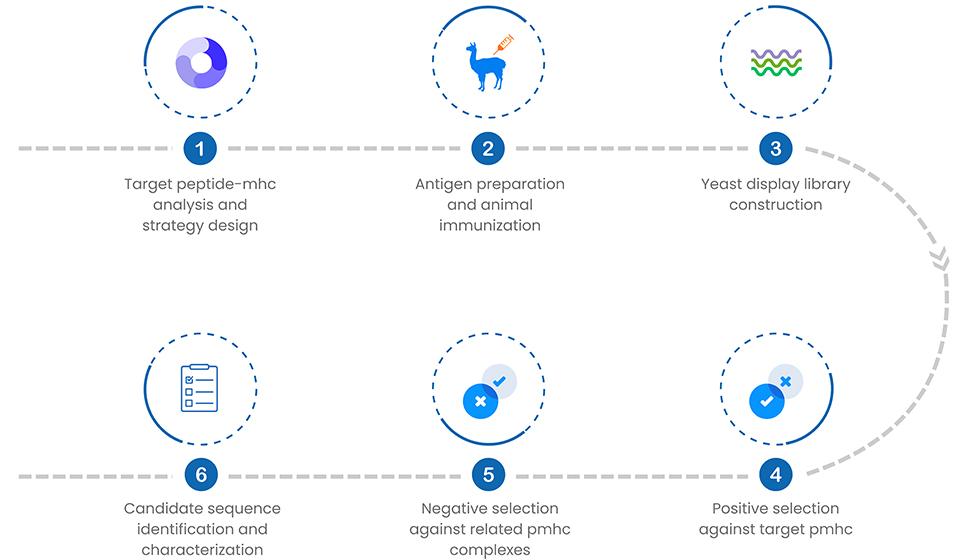
High-Stringency Yeast Display Screening:
Positive selection against target pMHC complexes
Negative screening against related pMHC complexes
Real-time affinity-based sorting
Enrichment of highly specific clones
These approaches help enrich highly selective TCRm nanobody candidates while minimizing off-target recognition.

Clients will receive:
TCR-mimic nanobody sequences
Specificity validation data
Expression-ready constructs (optional)
Comprehensive project report
Optional downstream services
|
Stage |
Deliverables |
Timeline |
|
Immunization |
Serum titer report |
8 weeks |
|
Library construction |
Immune phage or yeast display library |
3–4 weeks |
|
Library screening |
TCR-mimic nanobody candidates |
4-6 weeks |
|
Optional candidate production |
Purified VHH and expression-ready constructs |
2–3 weeks |
|
Optional validation |
Specificity and cell-binding assays |
2–4 weeks |
What is a TCR-mimic nanobody, and what is its research and clinical value? TCR-mimic (TCRm) nanobodies are engineered single-domain antibodies that specifically recognize peptide epitopes presented by major histocompatibility complex (MHC) molecules on the cell surface. By recapitulating the target recognition mode of T-cell receptors (TCRs), they combine the intracellular target accessibility of small-molecule inhibitors with the high targeting specificity of monoclonal antibodies. This unique mechanism enables precise targeting of disease-driving intracellular antigens, including cancer neoantigens and viral epitopes, unlocking new therapeutic avenues for traditionally "undruggable" targets.
What are the main application scenarios for TCR-mimic nanobodies? TCRm nanobodies are enabling tools for next-generation targeted therapeutics and diagnostics. Core applications include:
- Oncology: Precision targeting of mutated intracellular oncoproteins (e.g., KRAS G12D/V, p53 neoantigens) inaccessible to conventional monoclonal antibodies
- Neurodegenerative Disease: Detection of disease-specific pMHC signatures associated with Alzheimer’s and Parkinson’s disease, supporting early diagnosis and disease monitoring
- Infectious Disease: Targeting of viral peptide epitopes (e.g., SARS-CoV-2, influenza) presented on infected cells, enabling rapid therapeutic development
- Basic Immunology Research: Robust reagents for visualization of antigen presentation dynamics and immune synapse formation
How do you ensure the target specificity of TCR-mimic nanobodies? Target specificity is the primary validation criterion for our TCRm nanobody discovery workflow. All lead candidates are counter-screened against a panel of homologous pMHC complexes to achieve single-amino-acid resolution of target discrimination. Binding performance is further validated via in vitro assays(cell-based systems and protein-based systems).
What advantages does your TCR-mimic nanobody platform have over traditional TCR biologics? Relative to conventional soluble TCRs, which are limited by poor stability and challenging manufacturing, TCRm nanobodies exhibit superior thermal stability, facile expression in bacterial or yeast systems, and flexible engineering into bispecific and cytotoxic formats. These properties reduce R&D costs and enable scalable, consistent production for research and translational development projects.
What information is required to initiate a TCR-mimic nanobody project? Project initiation requires the target peptide sequence, corresponding MHC allele information, and any available functional or structural data for the target. Custom pMHC complex preparation services are available as needed. Pre-project feasibility consultation is recommended to optimize target selection and project design.