What Library Diversity Is Needed for Reliable VHH Screening
Nov.03,2026
Share:
Researchers developing diagnostics, biosensors, imaging probes, and targeted therapies need binders that recognize the right epitope and remain stable during testing. A Custom Nanobody Discovery Platform provides a structured route from antigen preparation to sequence confirmation and functional validation. This guide explains a custom VHH nanobody discovery service, a VHH library screening platform for difficult targets, and the key steps needed to build a reliable custom camelid nanobody development platform.
Traditional antibody discovery can require large molecules, complex expression systems, and repeated optimization. VHH domains, commonly called nanobodies, are much smaller single-domain binders. A typical VHH is about 12–15 kDa and contains one variable domain, while a conventional IgG antibody is about 150 kDa and has two heavy chains and two light chains. This smaller format can support bacterial expression, fusion-protein design, and access to recessed or sterically limited epitopes.
A Custom Nanobody Discovery Platform is an integrated service or workflow for finding VHH binders against a customer-supplied target. The process usually includes antigen assessment, immune or synthetic library selection, display-based screening, sequence analysis, recombinant expression, and activity testing.
In industry terms, a nanobody is a single-domain antibody fragment derived from camelid heavy-chain antibodies. The scientific term is usually VHH, meaning the variable domain of a heavy-chain-only antibody. VHHs retain antigen-binding loops but do not require a paired light chain. This makes them suitable for compact formats such as VHH-Fc, VHH-enzyme fusions, multivalent constructs, and fluorescent probes.
The word “custom” matters. Target type, epitope location, assay format, species cross-reactivity, affinity goal, expression host, and intended application all affect library selection and screening design. A platform designed for a soluble protein may not be suitable for a membrane receptor, virus-like particle, whole cell, or small-molecule conjugate.
What Is a Custom Nanobody Discovery Platform?
Compact size: A VHH is roughly one-tenth the mass of a full IgG, which can simplify fusion design and improve access to narrow binding sites.
Expression options: Many VHHs can be produced in systems such as Escherichia coli or yeast, depending on sequence and folding behavior.
Engineering flexibility: Researchers can connect VHHs to Fc domains, toxins, enzymes, nanoparticles, reporters, or additional VHH units.
Good structural stability: VHH frameworks contain conserved substitutions that support folding without a light chain. Stability still varies by sequence and must be measured experimentally.
Access to challenging epitopes: The long complementarity-determining region 3, or CDR3, may reach pockets and recessed surfaces that are difficult for larger antibodies to access.
These advantages do not mean every VHH is automatically better than an IgG. The final choice should depend on affinity, specificity, thermal stability, aggregation, expression yield, pharmacokinetics, and the intended use.
Why VHH Discovery Is Useful for Modern Research
Library diversity is one of the main factors controlling discovery quality. A library contains many VHH sequences displayed on phage, yeast, ribosomes, or another screening format. A larger library can increase the chance of finding useful sequence families, but the number alone does not prove quality. Functional diversity, correct folding, low clone bias, and broad CDR3 representation are equally important.
What Library Diversity Is Needed for Reliable VHH Screening?
Library design should balance sequence diversity, VHH folding quality, CDR3 coverage, and screening capacity.
Published antibody-display systems often report library sizes from approximately 108 to more than 1010 displayed variants. These figures describe theoretical or physical library size, not the number of unique, full-length, functional VHHs. A reliable evaluation should review:
Unique sequence count: How many non-identical VHH sequences remain after sequencing and quality filtering?
CDR3 length distribution: Are short, medium, and long CDR3 loops represented without excessive bias?
Framework quality: Do sequences contain stop codons, frame shifts, unusual cysteine patterns, or motifs linked to poor expression?
Display and expression performance: Are library members displayed at a level that supports selection?
Target class coverage: Has the library been tested against soluble proteins, membrane proteins, enzymes, or other difficult targets?
Negative selection design: Can the workflow remove binders to tags, carriers, plastic, beads, or related proteins?
A platform should not promise that a fixed library size guarantees a successful binder. Instead, the provider should explain how library quality is measured and how selection pressure is adjusted for the target.
How the Custom Nanobody Discovery Platform Works
1. Target and project assessment
The workflow begins with a target review. Important questions include:
Is the antigen soluble, membrane-bound, cell-associated, or part of a larger complex?
Which species and protein variants must the VHH recognize?
Should the binder recognize the native protein or a denatured form?
Is the desired epitope catalytic, receptor-binding, conformational, or tag-independent?
Will the final VHH be used for ELISA, flow cytometry, immunofluorescence, imaging, biosensing, or therapeutic research?
Target quality affects every later result. Purity, folding, oligomeric state, concentration, and buffer composition should be checked before screening. For membrane proteins, detergent choice, nanodiscs, liposomes, virus-like particles, or whole-cell presentation may be needed to preserve the native structure.
2. Library selection
There are two common strategies:
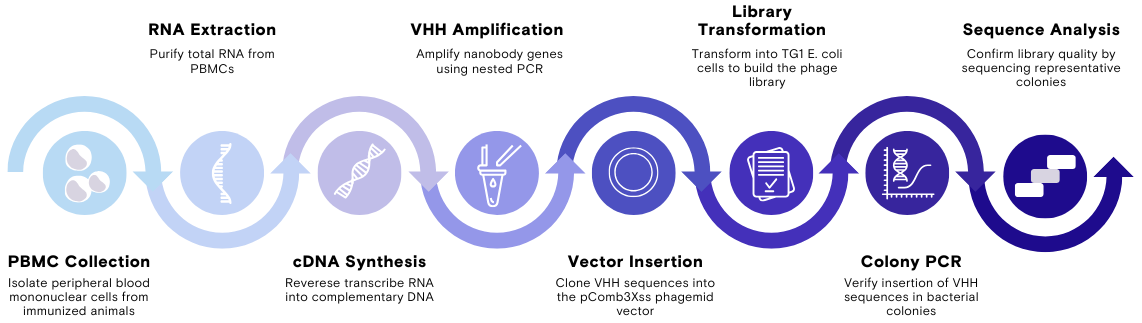
Immune libraries: VHH genes are collected from immunized camelids. These libraries may contain a strong response to the selected antigen and can produce binders with useful affinity.
Synthetic or semisynthetic libraries: CDR regions are designed or diversified in selected frameworks. These libraries support controlled sequence properties and can avoid animal immunization.
The correct strategy depends on the antigen, timeline, biosafety requirements, and desired sequence profile. A synthetic library may be useful when the target is toxic, poorly immunogenic, or difficult to use for immunization. An immune library may be valuable when a broad, natural immune response is preferred.
3. Display and biopanning
Phage display is widely used because each phage particle can connect a displayed VHH with its encoding DNA. A typical selection cycle includes target binding, washing, elution, amplification, and a new round of selection. The number of cycles should be controlled. Excessive selection can enrich sticky or fast-growing clones rather than the best functional binders.
Yeast display offers a different advantage: binding can be measured on individual cells by flow cytometry. This enables quantitative sorting based on target concentration, expression level, and binding signal. Ribosome and mRNA display can access very large in vitro libraries, although each format has its own technical limits.
Good selection design uses both positive and negative steps. Positive selection enriches target binding. Negative selection removes clones that bind unrelated proteins, tags, beads, cells, or the assay surface. For a therapeutic research target, cross-reactivity testing against homologous proteins should be included early rather than left to the final stage.
4. Clone identification and sequence analysis
After enrichment, individual clones are sequenced. Sequence analysis groups related clones into families and identifies repeated CDR3 patterns. Repeated sequences can indicate enrichment, but they do not prove specificity. A clone still needs an independent binding assay.
Useful quality checks include VHH framework annotation, CDR numbering, predicted liabilities, sequence uniqueness, and comparison with known antibody databases. IMGT provides widely used immunogenetics resources, while SAbDab provides structural antibody data that can support comparison and modeling.
5. Recombinant expression and purification
Selected VHH genes are transferred into an expression vector and produced in a suitable host. Common options include E. coli, yeast, and mammalian cells for more complex fusion formats. Purification may use affinity chromatography followed by size-exclusion chromatography or another polishing step.
At this stage, the key measurements are not only yield but also monomer percentage, purity, aggregation, and retained binding activity. A useful VHH should be tested in the same buffer and format planned for the final application because tags, linkers, labels, and multimerization can change its behavior.
6. Binding and functional validation
Binding assays answer different questions:
ELISA: Useful for initial target-binding comparisons.
Surface plasmon resonance or biolayer interferometry: Measures association and dissociation behavior. Key values include kon, koff, and the equilibrium dissociation constant, KD.
Flow cytometry: Tests binding to cells or membrane proteins in a near-native context.
Western blot: Helps determine whether a VHH recognizes a denatured protein.
Immunofluorescence: Tests staining performance, localization, background, and compatibility with fixation.
Functional assays: Determines whether the VHH blocks, activates, stabilizes, or reports a target-related biological event.
Affinity must be interpreted with specificity and function. A clone with a lower numerical KD may still be unsuitable if it binds a homologous protein or loses activity in a cell assay. For this reason, a complete report should show raw or summarized assay conditions, controls, target concentration, replicate number, and acceptance criteria.
Application Scenarios for VHH Nanobodies
Diagnostics and in vitro testing
VHHs can be used as capture or detection reagents in immunoassays, lateral-flow tests, and biosensors. Their compact format can support dense surface packing and fusion to signal-producing enzymes or nanoparticles. Assay development still requires testing matrix effects, detection limits, precision, interference, and long-term storage.
Cell biology and imaging
Fluorescent VHHs, sometimes called nanobodies for imaging, can be genetically or chemically linked to reporter molecules. Their small size may reduce the distance between a target and a fluorescent label. Researchers should compare background fluorescence, labeling ratio, photostability, and signal-to-noise ratio with the existing antibody reagent.
Therapeutic research
VHHs can be engineered into multivalent molecules, VHH-Fc formats, receptor agonists or antagonists, and targeted delivery systems. Preclinical development requires additional evaluation of immunogenicity, half-life, tissue distribution, off-target binding, stability, and manufacturability. Discovery success alone is not clinical validation.
Structural biology
VHHs can stabilize flexible proteins or capture a preferred conformational state. This can help researchers study membrane receptors, enzymes, and signaling proteins using methods such as cryo-electron microscopy or X-ray crystallography. The best structural binder may not be the strongest binder; a stable complex and a suitable epitope are also important.
Industrial and environmental detection
VHH-based sensors may be developed for toxins, contaminants, pathogens, food components, or process-monitoring targets. These applications often require tolerance to changes in pH, salt, temperature, and sample composition. Early stress testing can prevent a laboratory binder from failing in a real sample.
How to Choose a Custom Nanobody Discovery Platform Provider
Before starting a project, request clear answers to the following questions:
What type and size of VHH library will be used?
How is library diversity measured beyond the headline library size?
Which display method and selection rounds are planned?
How will non-specific and tag-binding clones be removed?
How many unique sequences will be delivered?
Will the provider express and purify the lead VHHs?
Which affinity, specificity, stability, and functional assays are included?
Are raw sequence files, chromatograms, assay conditions, and reports included?
Who owns the sequences and the resulting intellectual property?
Can the provider support optimization, humanization, affinity maturation, or scale-up?
A strong project plan defines measurable milestones. Examples include the number of unique binders, the percentage of monomeric protein after purification, the target-specific signal over negative controls, the measured KD range, and the percentage of activity retained after a defined stress condition. These metrics are more useful than general claims such as “high quality” or “strong affinity.”
Common Problems and Practical Solutions
Low or inconsistent target binding
This may result from protein misfolding, incorrect target presentation, low display quality, or an unsuitable buffer. Check target integrity, change the presentation format, and include a positive control when possible.
Many non-specific clones
Non-specific enrichment can occur when the target concentration is too high or when the surface, tag, bead, or carrier becomes the main selection feature. Add counter-selection and reduce target concentration during later rounds.
Good ELISA signal but weak cell binding
The VHH may recognize a denatured or artificial epitope. Test the clone against native protein, intact cells, or a membrane-protein format before prioritizing it.
Strong binding but poor expression
Sequence liabilities, exposed hydrophobic residues, unusual cysteine patterns, or aggregation can reduce yield. Compare related sequence families and evaluate framework engineering rather than changing only the purification method.
Affinity improves but specificity declines
Affinity maturation can increase off-target binding. Screen matured variants against homologous proteins and unrelated control proteins, then select using both affinity and specificity thresholds.
Scientific References and Recommended Resources
introduced the discovery of naturally occurring antibodies without light chains in camelids.
reviewed the structure, production, and applications of single-domain antibodies.
provides reference resources for immunoglobulin sequence and V-domain analysis.
provides an antibody structural database that can support sequence and structure comparison.
provides literature and sequence databases for confirming published VHH research.
FAQ About Custom Nanobody Discovery Platforms
What is the difference between a nanobody and a VHH?
In most research discussions, the terms are used in a similar way. VHH is the technical name for the variable domain of a camelid heavy-chain-only antibody. “Nanobody” is widely used for this single-domain antibody format, although some commercial names may have specific trademark ownership.
How long does a custom VHH discovery project take?
The timeline depends on the library, antigen, display method, number of selection rounds, sequence analysis, expression, and validation package. Ask for a stage-by-stage schedule instead of relying on a single total-day estimate.
What antigen amount is required?
There is no universal amount. Soluble proteins, peptides, cells, membrane proteins, and particles require different quantities and formats. A provider should assess purity, concentration, buffer, stability, and the amount needed for repeat selection and confirmation assays.
Can VHHs bind membrane proteins?
Yes, but the target must be presented in a structure that preserves the relevant epitope. Whole-cell display, purified membrane protein, nanodiscs, liposomes, or virus-like particles may be considered according to the project goal.
What data should be included in the final report?
A useful report should include clone sequences, CDR annotations, expression and purification data, binding curves, affinity measurements, negative-control results, cross-reactivity data, and functional assay results. It should also explain the test conditions and acceptance criteria.
Can the discovered VHH be optimized?
Many VHHs can be optimized through framework selection, affinity maturation, specificity screening, multimerization, linker design, or fusion to an Fc or reporter. Any change should be re-tested because improved affinity can affect stability, expression, or off-target binding.
Next Steps with 阿帕克
Start by defining the target, required epitope, application, species cross-reactivity, and preferred final format. Prepare the available antigen information and list the assays that will determine success. Then ask 阿帕克 to review the target and recommend a library, display method, selection plan, and validation package. This step-by-step approach makes a custom camelid nanobody development platform easier to evaluate and helps turn a promising VHH sequence into a reproducible research reagent.
Previous:
How Library Size Affects Phage Display Nanobody Discovery
Next:
How to Validate Hits from Premade Nanobody Libraries



 Yeast Display VHH Discovery Service
 Immunogen Design & Production
 Premade Library Screening
 Phage Display Nanobody Discovery Service
 Animal Immunization
 Yeast Display Peptide Library Screening

 Nanobody Discovery for ADC
 Nanobody Discovery for Membrane Targets
 Nanobody Discovery for Cell Therapy
 TCR-Mimic Nanobody Discovery


 Antibody Affinity Maturation Service
 Nanobody Humanization Service