Custom Nanobody Discovery Platform planning should connect scientific objectives, development risks, budget, timeline, and final product requirements from the beginning. This guide explains how to move from antigen definition to a qualified nanobody lead candidate, while addressing the practical concerns of purchasing teams and project managers. NBbiolab provides a structured framework for selecting the right discovery route, defining deliverables, and controlling quality at every stage.
1. Define the discovery objective before selecting a platform
Translate the intended use into measurable technical requirements
The first step is to define what the nanobody must do in the final application. A reagent for research, a diagnostic binder, an imaging agent, and a therapeutic candidate require different affinity, specificity, stability, and production standards. A clear project brief prevents the discovery team from optimizing for binding alone when the final product needs functional activity or strong manufacturability.
Record the following requirements before starting the campaign:
- Target identity, species, isoform, mutation status, and domain of interest.
- Required binding site or epitope, including whether a linear or conformational epitope is preferred.
- Desired affinity range, such as a target Kd or kinetic profile.
- Required specificity against homologous proteins, paralogs, or related antigens.
- Expected sample type, matrix, pH range, salt concentration, and temperature.
- Intended format, such as monovalent nanobody, multivalent construct, fusion protein, or conjugate.
- Expression system and scale required for downstream testing.
- Regulatory, documentation, sequence ownership, and data transfer requirements.
Address the main purchasing group pain points
Purchasing groups usually need more than a scientific statement that a vendor can discover binders. They need a predictable scope, transparent deliverables, and a clear basis for comparing proposals. The most common concerns include uncertain total cost, unclear acceptance criteria, long timelines, repeated requests for additional antigen, weak documentation, and candidates that bind in one assay but fail in the intended application.
A procurement-ready project plan should specify:
- What is included in the discovery package and what is charged separately.
- How many clones, sequences, expression samples, and characterization reports will be delivered.
- Which steps have go or no-go decision points.
- How failed antigen preparation, low expression, or weak hit rates will be handled.
- Whether intellectual property, sequence rights, and material ownership are transferred.
- How raw data, protocols, chromatograms, binding curves, and assay records will be supplied.
2. Select and prepare an antigen that supports useful binder discovery
Choose the antigen format according to the desired epitope
The second step is to select an antigen format that preserves the binding site required for the final application. A purified soluble domain may be suitable for a structural epitope, while a full-length membrane protein, virus-like particle, cell-based antigen, or stabilized complex may be needed for a conformational or multicomponent epitope.
Common antigen formats include:
- Purified recombinant protein for soluble target domains.
- Full-length protein for targets with multiple functional regions.
- Peptide for linear epitope discovery.
- Protein complex for interface-specific binders.
- Cell-based antigen for native membrane presentation.
- Virus-like particle or nanoparticle display for repetitive or conformational structures.
- Inactivated pathogen or pathogen-derived material when the target requires native context.
Perform antigen quality control before panning or immunization
Antigen quality strongly affects the quality of the final library and hit panel. Aggregated, degraded, misfolded, or incorrectly tagged antigen can produce irrelevant binders and reduce the chance of recovering functional candidates.
Recommended antigen checks include:
- Confirm identity by mass spectrometry, sequence information, or an authenticated expression record.
- Check purity by SDS-PAGE and, where appropriate, size exclusion chromatography.
- Assess aggregation and oligomeric state by SEC, dynamic light scattering, or analytical ultracentrifugation.
- Confirm folding with a known antibody, ligand, enzyme assay, or structural method.
- Measure concentration accurately using a suitable method rather than relying only on absorbance.
- Test stability during storage, freeze thaw cycles, and assay buffer exposure.
- Remove or control tags if the final binder must recognize the native target rather than the purification tag.
Plan antigen quantities and reserve material
Calculate antigen consumption for immunization, library panning, counter-selection, screening, and confirmation. Reserve additional material for troubleshooting and orthogonal validation. A common planning error is to purchase only the minimum amount needed for the first experiment, leaving no material for confirmation or application testing.
3. Choose the discovery route and build a risk-controlled workflow
Compare immunized, synthetic, and naive library strategies
The third step is to select the discovery route based on target biology, speed, available antigen, and downstream requirements. No single route is optimal for every project.
- Immunized animal libraries can provide strong affinity and natural sequence diversity after antigen-driven maturation, but they require immunization time and suitable animal welfare and compliance procedures.
- Synthetic libraries offer rapid access to designed sequence diversity and can be useful when immunization is not preferred, but library quality and framework design must be carefully evaluated.
- Naive libraries can support rapid discovery against many targets, but they may require more screening and affinity maturation to reach the desired performance.
- Hybrid strategies combine library screening with focused maturation, structure-guided design, or alternative display formats.
Set stage gates and acceptance criteria
Use stage gates to prevent uncontrolled spending and to make supplier comparisons easier. Each stage should have an expected output and an action if the result is below target.
- Gate 1: antigen passes identity, purity, folding, and stability checks.
- Gate 2: immunized animals or starting libraries show sufficient diversity or immune response.
- Gate 3: primary screening produces reproducible target-specific binders.
- Gate 4: confirmed clones show the required specificity and sequence uniqueness.
- Gate 5: expressed candidates meet affinity, stability, yield, and application assay criteria.
- Gate 6: one or more lead candidates pass developability and risk review.
Build a realistic timeline
A discovery campaign can take several weeks to several months depending on the route, antigen complexity, number of screening rounds, and depth of characterization. A typical project sequence includes antigen preparation, library generation or immunization, enrichment, clone screening, sequence analysis, recombinant expression, affinity measurement, functional testing, and developability assessment. The proposal should separate fixed-duration activities from activities that depend on experimental results.
4. Execute enrichment and screening with the right tools
Use a step-by-step panning or selection workflow
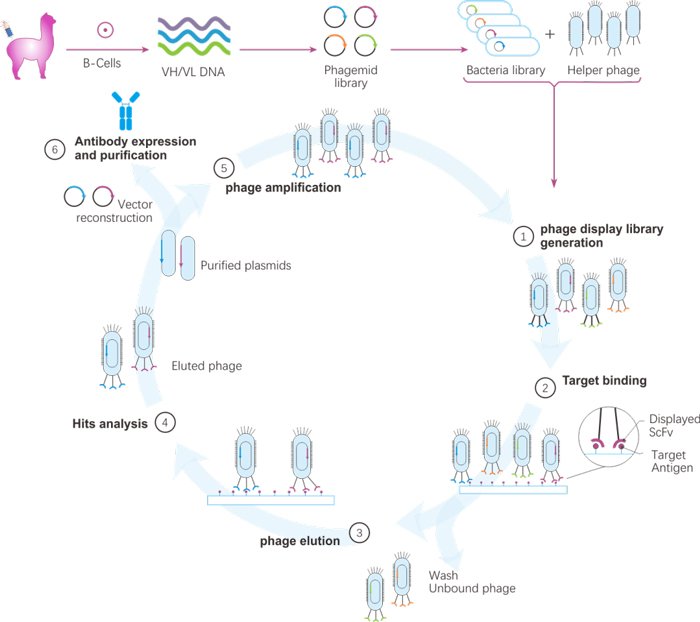
The fourth step is to enrich target-specific nanobodies while reducing nonspecific and tag-dependent binders. The exact method may use phage display, yeast display, ribosome display, mRNA display, or another platform, but the logic is similar.
- Prepare the target in a confirmed active or correctly folded form.
- Block the surface and materials used for selection to reduce nonspecific adsorption.
- Incubate the library with the target under defined concentration, time, temperature, and buffer conditions.
- Remove unbound and weakly bound members through controlled washing.
- Elute retained binders using a method that preserves recoverable diversity.
- Amplify or recover the selected population according to the display system.
- Repeat selection for multiple rounds while increasing stringency gradually.
- Introduce negative selection against tags, carrier proteins, beads, matrix components, or homologous targets.
- Monitor enrichment using polyclonal binding assays or sequencing rather than assuming that later rounds always improve quality.
- Pick individual clones for primary screening and retain enough diversity for backup analysis.
Required tools and materials
A complete planning list should include both discovery tools and quality control tools.
- Antigen expression and purification equipment or a qualified antigen supplier.
- Protein quantification, SDS-PAGE, SEC, and aggregation analysis tools.
- Phage, yeast, ribosome, or other display library resources.
- Microplates, automated liquid handling equipment, pipettes, and calibrated laboratory instruments.
- ELISA, flow cytometry, bead-based binding, or cell-based screening systems.
- DNA extraction, PCR, cloning, sequencing, and sequence analysis tools.
- Recombinant expression systems such as Escherichia coli, yeast, or mammalian cells.
- Protein purification tools including affinity chromatography and SEC.
- Biophysical instruments such as SPR, BLI, MST, or equivalent kinetic systems.
- Functional assay reagents, relevant cell lines, and homologous or off-target proteins.
- Sample tracking, electronic laboratory records, data analysis software, and secure data storage.
Use orthogonal assays instead of relying on one screening method
Primary screening is designed for throughput, not final proof. ELISA may identify binders that do not recognize the target in solution. Cell-based binding may detect avidity effects. Label-dependent assays may favor clones that recognize the label or carrier. Confirm hits using at least two assay formats with different detection principles.
5. Confirm sequence identity, specificity, and binding performance
Move from primary hits to verified unique clones
The fifth step is to remove false positives, duplicates, and weak candidates before investing in extensive characterization. Sequence each confirmed hit and group clones by complementarity-determining region similarity, framework, and likely binding mode.
- Re-test individual clones using the same antigen lot and a fresh assay plate.
- Sequence the variable region and verify the reading frame and framework integrity.
- Remove clones with stop codons, unexpected insertions, unstable motifs, or cloning artifacts.
- Group identical and closely related sequences to estimate true diversity.
- Express representative clones independently of the display system.
- Confirm binding using purified nanobody rather than displayed material.
- Test binding to unrelated proteins, purification tags, carrier proteins, and homologous targets.
Measure affinity and kinetics correctly
Affinity should be measured under conditions relevant to the intended application. Report association and dissociation behavior when possible, not only an apparent endpoint value. A very slow off-rate may be valuable for detection, while rapid reversible binding may be preferable for some purification or imaging uses.
Record the following data:
- Method used, instrument, temperature, buffer, and immobilization strategy.
- Analyte and ligand concentrations and the fitting model.
- Association rate, dissociation rate, and calculated equilibrium affinity.
- Signs of mass transport, rebinding, aggregation, or nonspecific surface interaction.
- Replicate results and acceptance limits.
6. Select a lead candidate based on function and developability
Evaluate function in the intended application
The sixth step is to test whether the nanobody performs the job required by the end user. Binding alone does not prove that a candidate is suitable. Functional testing may include receptor blocking, ligand competition, enzyme inhibition, neutralization, target capture, imaging signal, intracellular delivery, or diagnostic performance.
Functional studies should define:
- The biological model and target expression level.
- The concentration range and exposure time.
- The positive and negative controls.
- The performance metric and assay acceptance criteria.
- The effect of matrix, serum, lysate, or other application-specific components.
- Repeatability across operators, days, and reagent lots.
Assess developability before declaring a lead
A lead candidate should be selected using a balanced scorecard rather than the strongest affinity result alone. Developability problems discovered late can force a costly return to discovery.
Recommended developability tests include:
- Expression yield and recovery after purification.
- Purity, aggregation, oligomerization, and monodispersity.
- Thermal stability and storage stability.
- Resistance to freeze thaw cycles and agitation.
- Solubility across relevant formulation conditions.
- Protease sensitivity and serum stability when relevant.
- Non-specific binding, polyreactivity, and self-association.
- Compatibility with conjugation, labeling, multimerization, or fusion design.
- Sequence liabilities such as unpaired cysteines, chemical modification hotspots, and unfavorable hydrophobic patches.
Use a transparent lead scoring matrix
Rank each candidate against predefined weights. For example, function and specificity may receive the highest weight for a therapeutic or diagnostic program, while expression yield and storage stability may be more important for a routine research reagent. Keep the raw results visible so the final decision can be explained to scientific, quality, and procurement stakeholders.
7. Avoid common mistakes and control outsourcing risk
Common technical mistakes to avoid
- Starting with an antigen that is pure but not correctly folded.
- Using only one antigen format when the desired epitope is conformation dependent.
- Failing to remove tag binders and matrix binders during selection.
- Increasing panning stringency too quickly and losing useful diversity.
- Calling a clone positive from a single ELISA result.
- Comparing affinity values obtained under incompatible assay conditions.
- Ignoring expression yield, aggregation, or stability until the final stage.
- Choosing the highest-affinity clone without testing function or specificity.
- Using too little antigen and having none available for confirmation.
- Failing to preserve raw sequencing, chromatographic, and binding data.
Common purchasing and project management mistakes to avoid
- Comparing vendors only by the lowest initial quotation.
- Accepting vague terms such as high affinity or successful screening without numerical criteria.
- Not clarifying whether antigen production, assay development, sequencing, and expression are included.
- Failing to define what happens if no acceptable clone is found.
- Leaving sequence ownership, confidentiality, and intellectual property unresolved.
- Underestimating the time required for application-specific validation.
- Approving a project without a sample retention, data delivery, and change control plan.
Questions to ask a nanobody discovery supplier
- Which discovery route is recommended for this antigen and why?
- How is antigen quality verified before selection?
- How many selection rounds, clones, sequences, and expressed proteins are included?
- Which negative selections and off-target tests will be performed?
- What are the measurable criteria for a confirmed hit and a lead candidate?
- Which affinity, functional, and developability assays are included?
- What raw data and final reports will be delivered?
- What are the expected timeline, milestone payments, and potential additional costs?
- Who owns the sequences, materials, and resulting intellectual property?
8. Prepare the final lead package for downstream development
Define the minimum lead candidate data package
The final step is to convert discovery results into a package that can support engineering, formulation, assay development, or preclinical planning. A lead is not fully useful if the sequence is delivered without reproducible expression information, assay conditions, and risk data.
The final package should contain:
- Verified nanobody sequence and annotated framework and complementarity-determining regions.
- Expression construct map, host system, purification method, and yield information.
- Purity and identity data for the delivered material.
- Binding affinity, kinetic curves, assay conditions, and replicate results.
- Specificity and cross-reactivity results.
- Functional assay results using relevant controls.
- Stability, aggregation, solubility, and developability results.
- Recommended storage conditions and handling instructions.
- Sequence comparison showing unique and related clones.
- Open risks, proposed next experiments, and backup candidates.
Use the lead package to plan the next development stage
After lead selection, decide whether to proceed with affinity maturation, humanization or sequence optimization where applicable, multivalent formatting, conjugation, formulation, scale-up, or additional functional validation. Retain at least one backup candidate when the primary lead has unresolved stability, expression, or functional risks.
When evaluating a Custom Nanobody Discovery Platform, the strongest plan is one that links antigen quality, controlled selection, orthogonal validation, practical procurement terms, and lead developability. NBbiolab can help organize these stages into a clear discovery workflow with defined milestones and deliverables. A well-designed plan reduces rework, improves the chance of obtaining a usable lead, and makes the next development decision more predictable.
For projects that require a complete path from antigen to lead candidate, a Custom Nanobody Discovery Platform should end with actionable sequence, binding, function, stability, and manufacturing information rather than a list of unverified hits.



 Yeast Display VHH Discovery Service
 Immunogen Design & Production
 Premade Library Screening
 Phage Display Nanobody Discovery Service
 Animal Immunization
 Yeast Display Peptide Library Screening

 Nanobody Discovery for ADC
 Nanobody Discovery for Membrane Targets
 Nanobody Discovery for Cell Therapy
 TCR-Mimic Nanobody Discovery


 Antibody Affinity Maturation Service
 Nanobody Humanization Service