Introduction: Humanization Beyond Immunogenicity
Early therapeutic antibodies were predominantly derived from murine hybridomas. However, murine antibodies frequently elicit human anti-mouse antibody (HAMA) responses, leading to accelerated clearance, reduced efficacy, shortened serum half-life, and potentially severe immune-related toxicities, thereby limiting their clinical translation.[1]
Originally developed to reduce immunogenicity, antibody humanization has evolved into a comprehensive engineering strategy aimed at simultaneously preserving or improving antigen-binding affinity, structural stability, expression, and overall developability. Consequently, humanization is now regarded as an integral component of antibody engineering rather than a downstream optimization step.
1. Classical Humanization: CDR Grafting and Its Limitations
Complementarity-determining region (CDR) grafting is the classical strategy for antibody humanization. It is based on the premise that antigen specificity is primarily determined by the CDRs, while the framework regions (FRs) mainly provide structural support. Accordingly, murine CDRs are transplanted onto human germline frameworks to generate humanized antibodies.[2]
In practice, however, CDR conformation is strongly influenced by the surrounding framework. Vernier zone residues, VH–VL interfacial interactions, and the hydrophobic core all contribute to maintaining the structural integrity of the antigen-binding site. Alterations to these elements may perturb CDR geometry, resulting in affinity losses ranging from one to three orders of magnitude.
To restore binding activity, back mutations are frequently introduced by retaining or reverting selected murine framework residues. These residues are typically located adjacent to the CDRs, within the VH–VL interface, or at positions critical for maintaining canonical loop conformations.
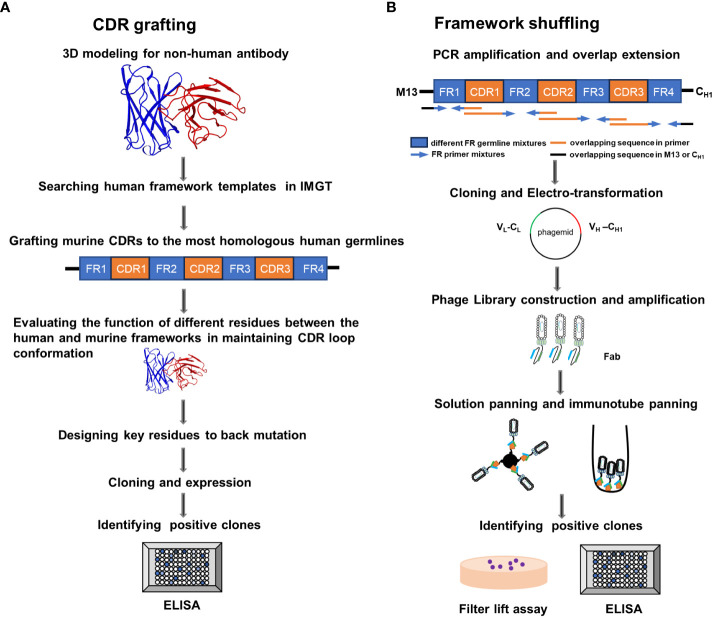
Figure 1. Schematic illustration of complementarity-determining region (CDR) grafting and framework shuffling strategies for antibody humanization.[3]
An alternative approach, framework shuffling, constructs libraries of multiple human framework combinations and experimentally identifies those most compatible with a given set of CDRs. By exploring a broader design space, framework shuffling has, in some cases, outperformed conventional CDR grafting.[3] Nevertheless, both approaches still rely heavily on empirical design and iterative experimental optimization, limiting their efficiency and scalability.
2. Structure-Guided Humanization: From Empirical Design to Rational Engineering
Advances in structural biology have transformed antibody humanization from empirical trial-and-error into a more rational engineering process. High-resolution X-ray crystallography and cryo-electron microscopy (cryo-EM) now enable atomic-level characterization of antibody structures, allowing key determinants of CDR conformation to be identified and preserved during humanization.[4]
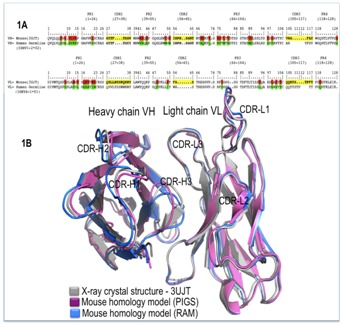
Figure 2. Sequence and structural alignment of the murine antibody 3UJT.[4]
Structure-guided humanization focuses on identifying residues that are critical for structural integrity, including those within the hydrophobic core, hydrogen-bonding networks, and VH–VL interface. Direct replacement of these residues with human counterparts may compromise structural stability and antigen binding. Consequently, selective humanization is often employed, preserving key non-human framework residues while humanizing solvent-exposed regions to balance functionality and reduced immunogenicity.
For example, in the humanization of a BCMA-targeting antibody, structure-guided mutagenesis identified substitutions that preserved the antigen-binding interface, successfully restoring binding affinity while maintaining a humanized framework.[5]
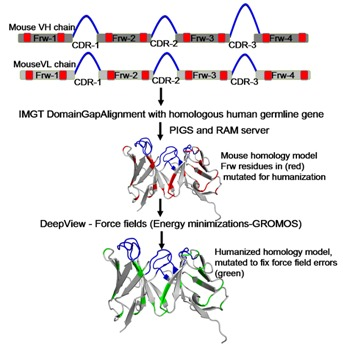
Figure 3. Structure-guided humanization based on homology modeling and energy minimization (simulated annealing).[4]
Modern humanization also considers developability alongside antigen binding. Critical properties—including thermal stability, aggregation propensity, expression, and pH stability—are routinely evaluated because they directly influence manufacturability, formulation, and downstream clinical development.[6]
3. AI-Driven Humanization: The Shift Toward Data-Driven Design
The emergence of large-scale antibody sequence repositories, exemplified by the Observed Antibody Space (OAS) database, has provided the foundation for applying deep learning to antibody humanization.[7]
Leveraging these datasets, several AI-based humanization platforms have been developed. Among them, BioPhi integrates two complementary modules—Sapiens and OASis—to evaluate antibody humanness from different perspectives. Sapiens employs deep neural networks trained on human antibody repertoires to assign residue-level humanness scores, whereas OASis assesses potential immunogenicity by identifying non-human peptide fragments that may constitute T-cell epitopes. Together, these tools move humanization beyond simple sequence identity toward a probabilistic assessment based on human antibody repertoire distributions.[8]
Similarly, models such as AbNatiV use generative architectures, including variational autoencoders (VAEs) and transformers, to quantify antibody nativeness—a metric that correlates with immunogenicity risk. Importantly, these models are not limited to sequence evaluation; they can also guide sequence optimization by introducing mutations that increase humanness while preserving antibody function.
Compared with conventional approaches, AI-driven humanization offers several advantages. It captures cooperative effects among multiple residues across the entire variable domain rather than optimizing mutations individually, and it can be applied even in the absence of high-resolution structural information, substantially expanding its applicability during early-stage antibody engineering.
4. Global Design Strategies
Beyond deep learning, another emerging strategy employs physics-based energy functions to guide antibody humanization. A representative example is CUMAb (Computational hUMan AntiBody design).
Rather than selecting the single closest human germline framework, CUMAb systematically grafts the parental CDRs onto thousands of human framework combinations and ranks the resulting designs using Rosetta-based structural modeling and energy calculations.[9]
By searching a much larger design space, CUMAb identifies framework combinations that best preserve antibody structure and function. In multiple case studies, CUMAb-generated antibodies maintained binding activity while exhibiting improved stability or expression compared with conventionally humanized variants. Conceptually, this approach reframes antibody humanization as a multi-objective optimization problem, balancing humanness, structural integrity, and developability through computational design.
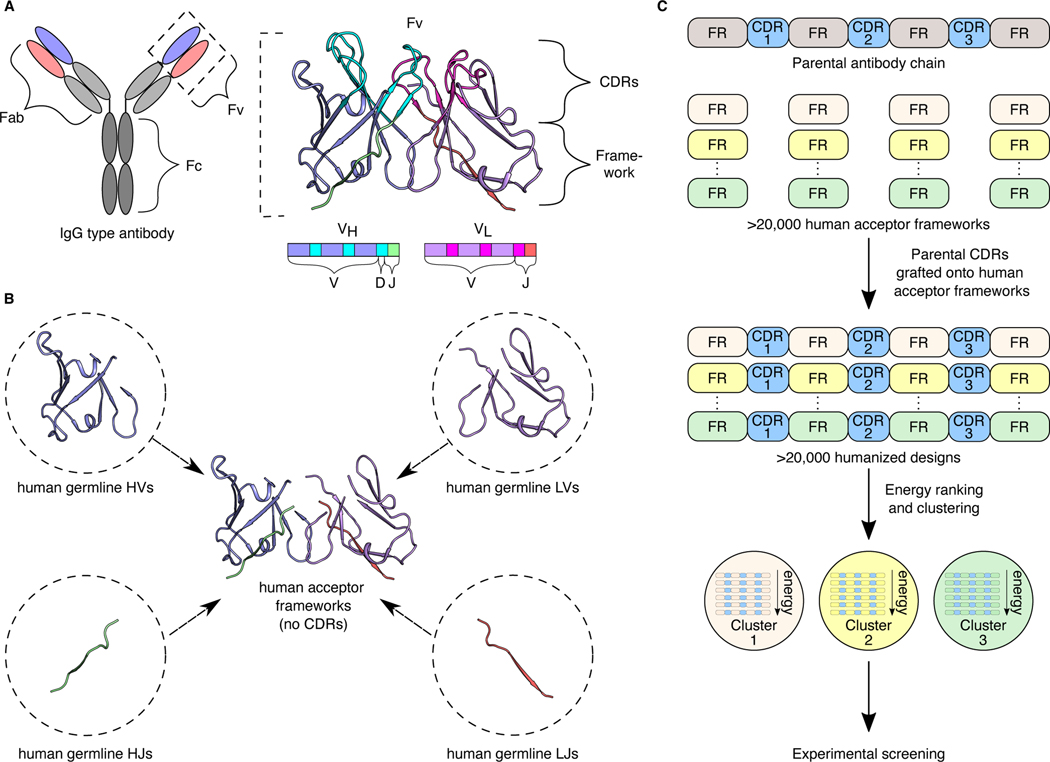
Figure 4. Workflow of the CUMAb humanization strategy. (A) Schematic representation of antibody variable domains. (B) Human framework candidates are generated by systematically combining human germline V- and J-region genes for both heavy and light chains, yielding more than 20,000 candidate frameworks for each parental antibody. (C) Murine CDRs are grafted onto each framework, followed by Rosetta-based structural modeling and energy evaluation. Candidate designs are subsequently clustered, and representative antibodies from low-energy clusters are selected for experimental validation.[9]
5. Nanobody Humanization
Humanization of single-domain antibodies (VHHs) presents distinct challenges compared with conventional IgG antibodies. Because VHHs are derived from camelids and naturally lack a light chain, their framework regions—particularly framework region 2 (FR2)—contain unique hydrophobic residues that are essential for maintaining solubility, structural stability, and proper folding.[10,11]
Consequently, conventional IgG humanization strategies cannot be directly applied to VHHs. For example, indiscriminate replacement of FR2 residues with human counterparts may compromise solubility and increase aggregation propensity. Current approaches therefore adopt a more conservative strategy, retaining structurally critical framework residues while progressively introducing human-like sequence features. Dedicated computational tools, such as Llamanade, further facilitate VHH humanization by identifying sequence differences between camelid and human antibodies and prioritizing rational substitutions. Overall, successful VHH humanization requires balancing increased humanness with preservation of the unique structural properties that underpin nanobody function.
6. A Practical Humanization Workflow
Based on current best practices, antibody humanization is typically performed through an iterative design–evaluation–optimization workflow:
①Sequence and structural analysis of the parental antibody.
②Initial humanization design, using CDR grafting, multiple germline framework candidates, or AI- and energy-based design strategies.
③In silico evaluation of candidate sequences, including humanness assessment, structural stability, immunogenicity prediction, and developability profiling.
④Experimental validation of key properties, including antigen-binding affinity, expression, and biophysical stability.
⑤Iterative optimization guided by computational predictions and experimental results.
This integrated workflow combines computational design with experimental validation to accelerate antibody optimization. Increasingly, immunogenicity assessment, developability prediction, and pharmacokinetic profiling are incorporated at early stages to improve candidate quality and reduce development timelines.
Conclusion
The evolution of antibody humanization can be broadly divided into three stages:
①Empirical design, centered on CDR grafting and sequence homology.
②Structure-guided engineering, enabled by advances in structural biology.
③Data-driven optimization, powered by deep learning and large-scale antibody repertoire datasets.
Looking ahead, antibody humanization is expected to further integrate generative artificial intelligence, protein language models, and automated experimental platforms to enable closed-loop antibody engineering. As a result, humanization is evolving from a strategy focused solely on reducing immunogenicity into a multi-objective optimization process that simultaneously balances humanness, developability, structural stability, and biological function. Ultimately, the challenge is no longer simply to make non-human antibodies appear more human, but to identify the optimal solution within a complex therapeutic design space.
References
[1].J Biomed Sci. 2020 Jan 2;27(1):1. doi: 10.1186/s12929-019-0592-z.
[2].Sci Rep 8, 14820 (2018). https://doi.org/10.1038/s41598-018-32986-y
[3].Front Immunol. 2024 Jul 15;15:1395854. doi: 10.3389/fimmu.2024.1395854
[4].Bioinformation. 2014 Apr 23;10(4):180–186. doi: 10.6026/97320630010180
[5].J Mol Med (Berl). 2024 Jul 25;102(9):1151–1161. doi: 10.1007/s00109-024-02470-4
[6].Proc Natl Acad Sci U S A. 2017 Jan 17;114(5):944–949. doi: 10.1073/pnas.1616408114
[7].Protein Sci. 2021 Oct 29;31(1):141–146. doi: 10.1002/pro.4205
[8].MAbs. 2022 Jan-Dec;14(1):2020203. doi: 10.1080/19420862.2021.2020203
[9].Nat Biomed Eng. 2023 Aug 7;8(1):30–44. doi: 10.1038/s41551-023-01079-1
[10].MAbs. 2015 May 27;7(4):693–706. doi: 10.1080/19420862.2015.1046648
[11].J Biol Chem. 2009 Jan 30;284(5):3273-3284. doi: 10.1074/jbc.M806889200
Previous:
Masking Peptide Technologies for Antibody Therapeutics: From Undruggable Targets to Conditionally Activated Medicines
Next:
sdAbs Half-life extension strategy



 Yeast Display VHH Discovery Service
  Immunogen Design & Production
  Premade Library Screening
  Phage Display Nanobody Discovery Service
  Animal Immunization
  Yeast Display Peptide Library Screening
 Nanobody Discovery for ADC
  Nanobody Discovery for Membrane Targets
  Nanobody Discovery for Cell Therapy
  TCR-Mimic Nanobody Discovery

 Antibody Affinity Maturation Service
  Nanobody Humanization Service