.
Phage display is a well-established and widely used in vitro selection technology for the discovery of antibodies and other binding molecules. By displaying peptides or antibody fragments on the surface of bacteriophages, this technology enables the rapid identification of binders against a wide range of target types.
NBbiolab Phage Display platform is based on the M13 filamentous bacteriophage system. In this system, VHH or antibody fragment genes are fused to the gene encoding the phage coat protein pIII. The fusion proteins are displayed on the surface of the phage particles, while the encoding DNA is packaged inside the phage.
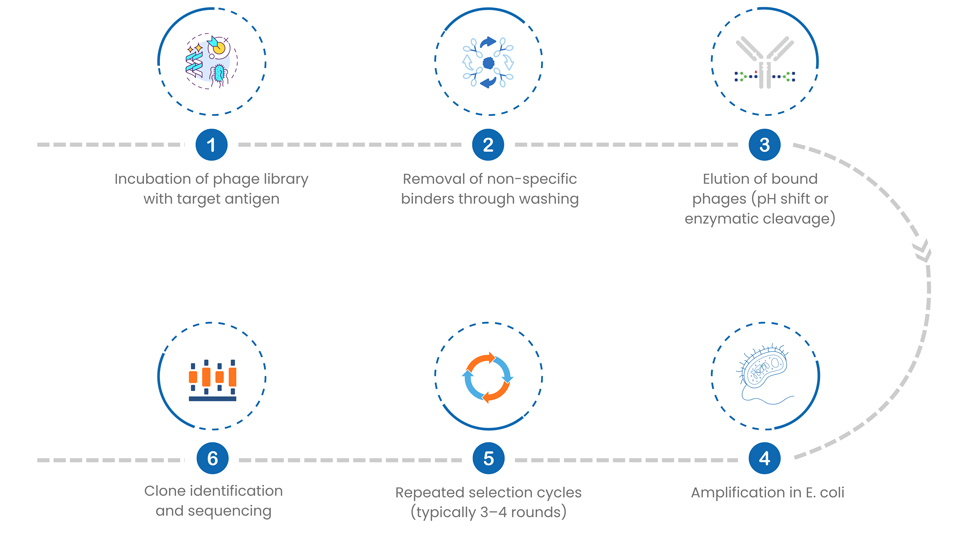
In this system, the phenotype (displayed protein) is physically linked to its genotype (encoding DNA), allowing efficient enrichment of target-specific binders through iterative selection and amplification cycles.
Our platform ensures high-quality phage display libraries through optimized molecular design and strict quality control.
Zero-Background Cloning
Background-free cloning technology ensures near-complete insertion efficiency and eliminates empty vectors.
Library Diversity
Phage display libraries typically exceed 1 × 10⁹ clones, enabling broad coverage of antibody diversity.
Clonal Uniqueness
Random clone sequencing confirms high diversity with no detectable sequence duplication.
ORF Accuracy
Sequencing validation ensures >90% correct open reading frames.
Our platform supports flexible screening strategies based on target characteristics.
Solid-Phase Screening
Antigens immobilized on plates or solid surfaces
Widely used for purified protein targets
Liquid-Phase Screening
Antigen binding occurs in solution
Suitable for cell surface proteins or conformational epitopes

Key advantages of our phage display platform include:
Direct genotype–phenotype linkage for efficient selection
Ultra-large library capacity for broad diversity coverage
Flexible screening formats adaptable to different target types
Compatibility with a wide range of antigens
Rapid enrichment through iterative panning cycles
Robust and well-established technology
Our phage display platform supports a wide range of applications and molecular formats.
Target Types
Purified proteins
Membrane proteins
Whole cells
Tissue samples
Biotinylated antigens
Molecule Formats
Nanobodies (VHH)
scFv and Fab fragments
Peptides and other protein binders
This versatility makes phage display particularly suitable for early-stage discovery and challenging targets.
This platform supports several CRO services:
Phage Display Nanobody Discovery